Six Permanente Medical Groups earn recognition from the AMA for initiatives in physician wellness and burnout reduction.
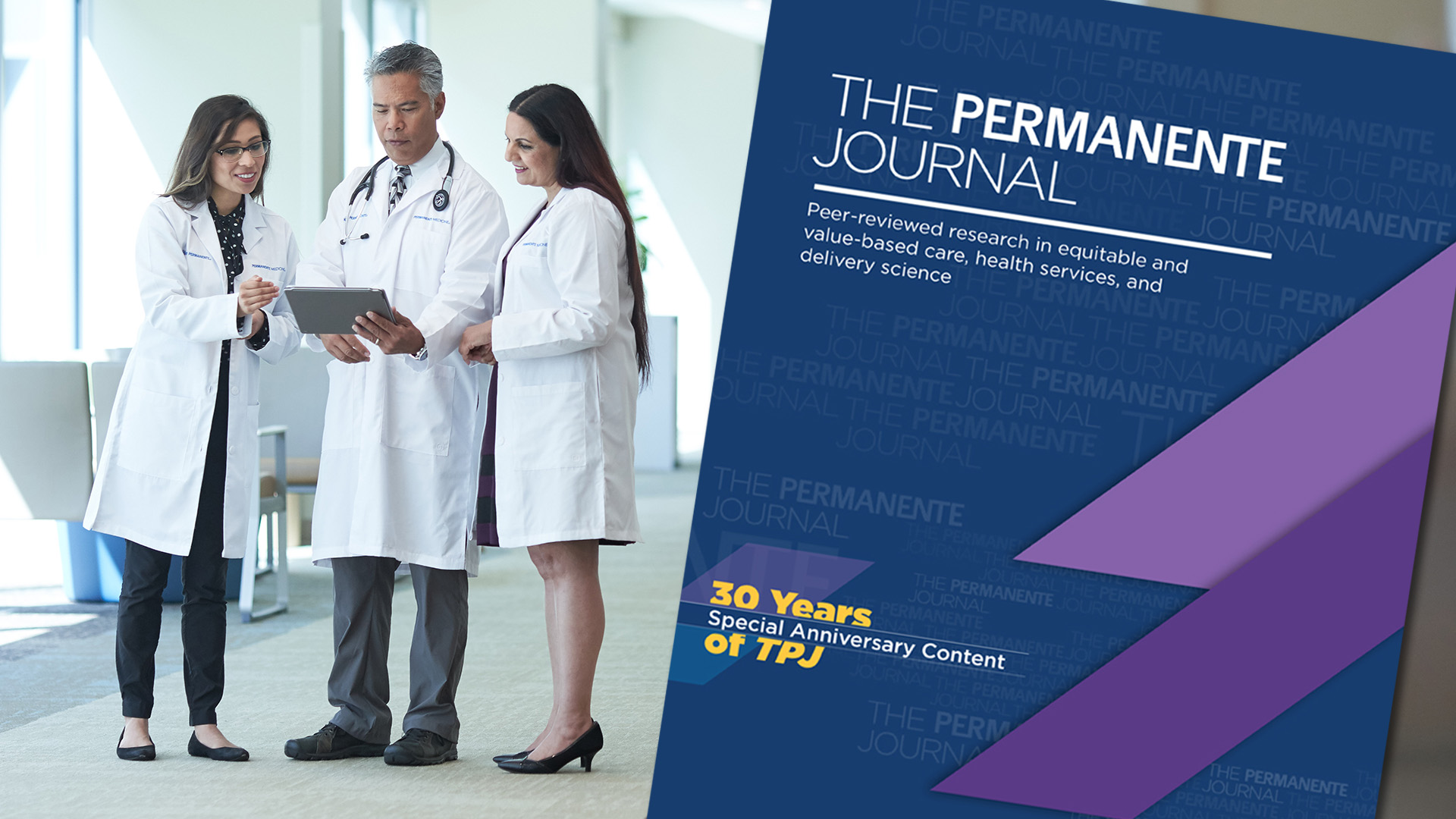
The Permanente Journal at 30: A look at its role in care delivery research


For 30 years, The Permanente Journal has documented clinical practice, health care delivery research, and ideas emerging from researchers and clinicians around the world. Throughout this year, the journal looks back at its origins and evolution while examining how its role is changing in a more digital, open-access publishing environment.
For physicians and health care leaders, the anniversary offers more than a retrospective. It highlights how a medical journal can help translate clinical experience and health system learnings into evidence that is easier to find, cite, and apply.
“Over the course of [the journal’s] existence, so many professionals have been instrumental in its growth and development, and its contributions to health care can be attributed to all who have participated,” wrote G. Richard Holt, MD, the journal’s editor-in-chief, in his latest editorial.
Holt’s message included reflections from others who helped shape the journal, among them Scott Young, MD, of The Permanente Federation and Kaiser Permanente’s Care Management Institute. “The journal’s growth is evident not only in the breadth and rigor of its scholarship, but also in its embrace of digital dissemination,” Young said, pointing to the journal’s numerous advances in indexing, branding, and workflow enhancement.
Milestones in visibility and reach
The journal is indexed in several major medical and scientific databases including PubMed, PubMed Central, Scopus, ResearchGate, and EBSCO. Inclusion in leading indexes is a significant achievement, given the rigorous criteria for acceptance. Further indexing expansions are anticipated. “Where a journal is indexed matters,” said Stephen Parodi, MD, vice president of The Permanente Federation, which publishes the journal. “Indexing status is not only a mark of prestige for a journal, but an important aspect of discoverability for busy clinicians and researchers.”
Related story: What’s causing the physician shortage and how to fix it: The Permanente Journal panel
The Journal, reimagined
In 2021, The Permanente Journal undertook a rebranding effort that included revising its aims and scope, refreshing its visual identity and updating its website. This work positioned the journal as an important venue for scholarly content in value-based care, health care delivery research, and integrated delivery systems, while maintaining its broader role as a platform for clinical research across medical disciplines.
The rebrand — guided by an interdisciplinary steering committee comprised of leaders from all Permanente Medical Groups — was followed by a publishing model change aimed at reducing barriers to participating in scholarship.
Related quality care story: Self-described ‘knowledge-seeker’ leads relaunch of The Permanente Journal
Expanding participation by open access
Although the journal has always been free to read, The Permanente Journal became fully diamond open access in 2023. Under this model, authors retain copyright to their accepted articles and publish under an exclusive license rather than transferring ownership. Importantly, authors pay no publication fees, and accepted articles are published without embargo and are immediately citable from online-first publication.
Recent high-interest articles include “Why Have All the Doctors Gone? Insights Into Early Clinical Departure Among Physicians in the United States: A National Survey” by authors Sea Chen, MD, PhD, and colleagues out of the American Medical Association, and Comparing Kaiser Permanente Members to the General Population: Implications for Generalizability of Research by authors Anna C. Davis et al. Both are among the journal’s most accessed, impactful articles.
The journal has also published expert panel discussions on current challenges in health care and clinical practice, including “Strengthening the Physician Workforce: An Expert Panel Discussion” moderated by Ted O’Connell, MD, and “Moving the Needle Toward True Value-Based Care: An Expert Panel Discussion” led by Nancy Gin, MD, FACP. These and other panels bring together a diverse range of voices to discuss some of today’s most-pressing topics in health care and clinical practice.
Readers have found value in the journal’s release of special sections, such as Improving Health Care Access (2026) and Trauma-Informed Health Care (2024), while those in research communities have cited “Comparing Kaiser Permanente Members to the General Population: Implications for Generalizability of Research” by Elizabeth McGlynn and colleagues over 350 times.
Get all the articles included for the 30th anniversary acknowledgment sent straight to your inbox. Sign up to receive journal alerts from The Permanente Journal.
Related Posts