Experts share how to embed suicide prevention into all levels of the health system using data, proactive screenings, and a commitment to saving lives.
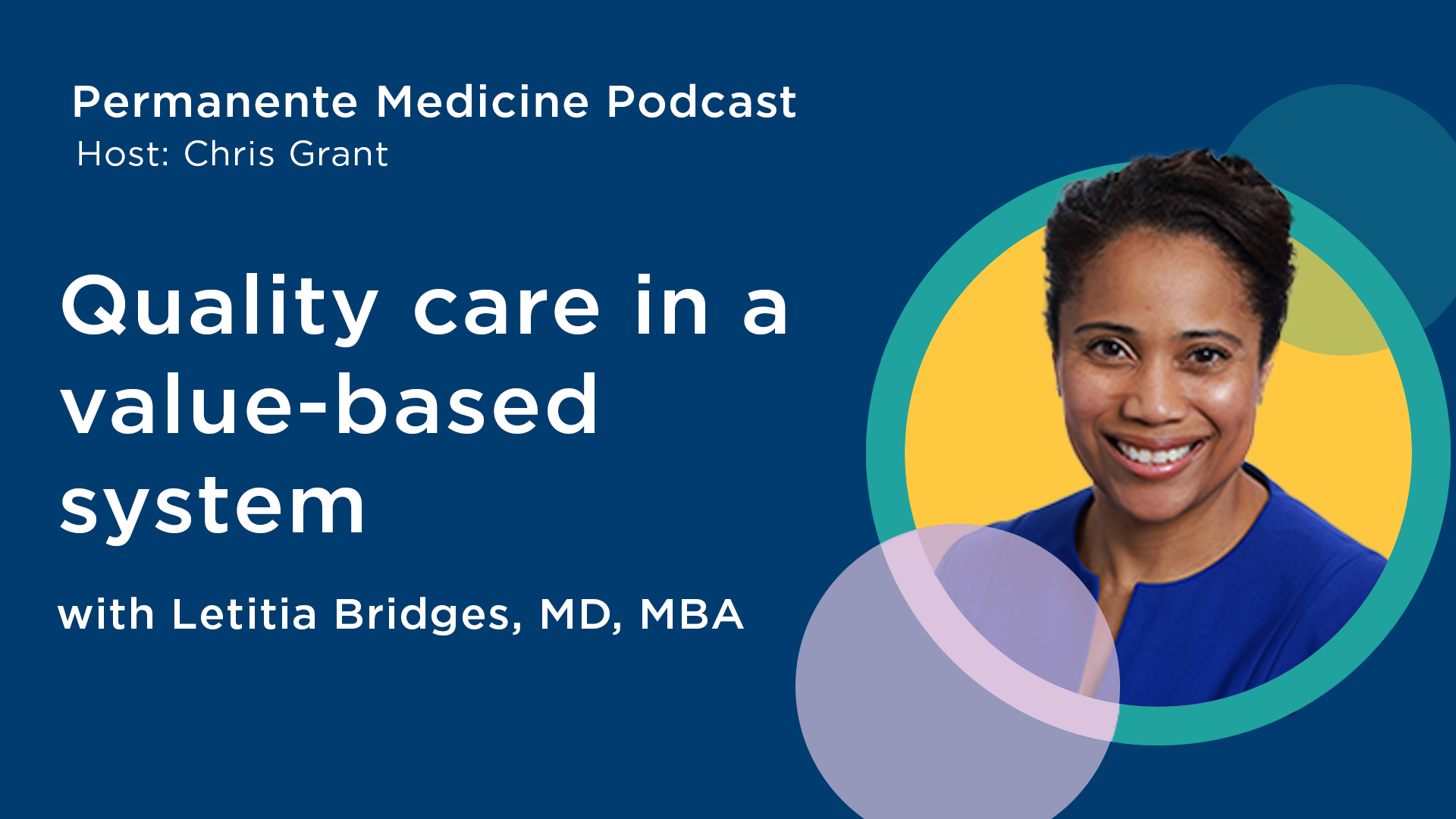
Podcast: Quality care in a value-based system


Quality as our North Star: A conversation with Letitia Bridges, MD, MBA



In this episode of the Permanente Medicine Podcast, host Chris Grant sits down with Letitia Bridges, MD, MBA, executive vice president and chief quality officer for The Permanente Federation.
Dr. Bridges offers a compelling perspective on how systems, values, and human relationships drive high-quality care and how Kaiser Permanente’s value-based, physician-led model enables better outcomes.
Dr. Bridges also explores how the story of care quality begins with a commitment to prevention and early diagnosis, extends into cancer care, perioperative safety and chronic disease management, and continues with long-term survivorship. The conversation covers how the demographic impact of aging populations and the younger generations of Gen Z and millennials are having on health care delivery.
The episode highlights the role of emerging technology and evolving patient expectations in shaping the future of medicine—and offers personal reflections on mentorship, purpose, and the importance of relationships.
Watch the full episode on YouTube:
Connect with Chris Grant by following him on X at @cmgrant or LinkedIn.
Follow us: Subscribe to the Permanente Medicine Podcast on your favorite streaming platform.
Podcast transcript
Transcript is autogenerated. Although edited for clarity, it should not be considered an exact replication of the podcast and may also be updated as needed.
Leticia Bridges, MD, MBA: This idea of a North Star really is what is it that we’re all committed to patients, physicians, the system, all of it together. As we navigate all of the change that’s coming, we know that won’t change. But when you have a North Star, you’re able to see through all of the noise and continue to move in the right direction. And I think that’s one of the areas where we’ve really just been quite frankly brilliant, is no matter what the disruption is, we have our North Star that is excellence in care.
Chris Grant: Welcome to the Permanente Medicine Podcast. I’m your host, Chris Grant, the chief operating officer at Kaiser Permanente, the Permanente Federation. In this discussion, we will address the significance of quality care and its role in ensuring medical excellence and positive patient experiences. We are joined today by Dr. Leticia Bridges as our guest for this episode. Earlier this year, Dr. Bridges became executive vice president and chief quality officer for The Permanente Federation and co-chair of the Kaiser Permanente National Quality Committee. As chief quality officer, Dr. Bridges oversees coordination of quality care programs across Kaiser Permanente for its 12.6 million members. She also serves as regional medical director of quality and clinical analysis for the Southern California Permanente Medical Group, and I’ve had the opportunity to work alongside Dr. Bridges and see her extraordinary capabilities firsthand. Dr. Bridges, thanks for being with us today.
LB: My pleasure. Excited to join you.
CG: Alright, let’s dive in and give our listeners a bit of new insight. We’re excited about your new national leadership role and quality for the Permanente Medical Groups. First, can you tell us a little bit about your background in previous roles?
LB: My story starts like everyone else’s with the residency training. I trained here in Los Angeles in general surgery, and during the course of that training I also pursued and completed Master’s in business administration. And over the course of my training, I’ve really been struck by the operational inefficiencies in medicine. And so that really inspired me to look for a job that I would have the opportunity to both be a practicing surgeon and to think about leadership as it related to our physician practice. My initial leadership position was actually in bioethics, which was really fascinating, and I moved on to perioperative leadership to leadership in the home care space. I’ve been an assistant area medical director and obviously a medical director and chief of staff at one of our two hospital facilities. It’s one of the, I think most fascinating opportunities within the Permanente infrastructure is this ability to deliver clinical care while you’re leading and designing the systems in which you work.
CG: When Dr. Davidoff came to me and spoke with me about your new role, he said “You’re going to love Dr. Bridges because she’s a driver of innovation and a driver of change.” What goals are you most excited to focus on as you step into this position?
LB: This role is about excellence in clinical quality. My perspective is that millions of people are relying on us to deliver high quality clinical care. They’re really relying on us to communicate with empathy. They’re relying upon us to have a safe perioperative journey. They’re relying on us to capture their cancer diagnosis and to treat it. And when you think about what’s at stake within medical care, we need an infrastructure that really delivers on excellence. And that’s for every patient from cradle to grave, every single visit. And as I’m thinking about my priorities, it is very much that mindset, infusing that mindset into the work that we do every single day. And of course there are the more traditional things of thinking about what are the clinical areas of focus that deliver the greatest impact to our patients? How do we deliver on excellence in diabetes care and hypertension, again at scale, consistently at every touch point. And as you mentioned earlier, a particular passion of mine is actually building in on the systems of care. How do we start to think about where we can deliberately and intentionally design our system to deliver on all of the process and evidence basis that exists within a disease state? And so I am very excited to take on the thinking around what the perioperative journey should look like. How do we start to think about lifestyle and obesity medicine, tackling the problems of pediatric obesity? We have tremendous opportunity and tremendous need.
CG: Before we dive into the details around quality programs and outcomes, could you share something about what you enjoy doing outside of medicine with our listeners?
LB: Surgeons have many shared beliefs and practices, and one of them is that you’re born a person and that you die a surgeon. And what that means is that like motherhood, it is a lifelong commitment to who we are and to how we live our lives. And so my philosophy is very much work hard, play harder. I’m always on. I’m fortunate to have three very rambunctious teenage boys and they keep me excessively active in all of their competitive activities from choir to basketball. On vacation — I use that with air quotes — you’ll find me navigating the Chasm of Doom in Joshua Tree, exploring snake farms and being on a boat in Louisiana while feeding marshmallows to alligators. It’s a really exciting life that I lead and I think that I find myself learning and relearning how to really deeply engage both at work and at home.
How value-based care and prevention drive quality care
CG: You have one of the most complex jobs in health care to lead quality across the largest health care delivery system in America. Independent organizations, and this is one of the things I’m so proud of, such as the National Committee for Quality Assurance and U.S. News and World Report frequently recognize Kaiser Permanente for its high-quality care. Could you elaborate on how our value-based model contributes to earning these distinctions?
LB: I love this question because now we have the opportunity to brag on the power of Permanente. We have extraordinary clinicians operating in an intentionally designed, evidence-based, continually evolving system that’s supported by technology. And when we start to take a step back, that’s the underpinning of value. And our philosophy with excellence, it really starts from prevention. We think about what are we doing with the primary prevention, what are we doing in our communities to support the well-being that we know that our members deserve? And then how do we stretch that excellence from primary to secondary prevention? I think it’s very well known at this point that we lead the nation in many of our cancer outcomes. It is because members that are navigating their cancer care also get best in class cardiac care, best in class surgical care if they should need it. Everything is evidence-based, integrated and aligned.
And when we start talking about value-based care, it is doing the right thing according to the evidence, according to that individual member at the right time. The other thing that I think that is an important part of this conversation that we often leave out is that health care is not just about the journey across the disease state. It is very much about survivorship. And so we talk about early diagnosis, we talk about the rigor in the treatment processes, but what comes next is just as important. Am I surveilling you 2, 3, 4 years later? Am I able to pick up a recurrence sooner rather than later? What do I do when that recurrence? Am I following the evidence at that point? Do I offer you all of the interventions that you deserve in a step-wise kind of coordinated fashion? And so the beauty and the power of Permanente really sits in these longitudinal relationships and it also sits in our ability to reach into your family and to help you identify the support that you need so that you have not just the medical support but the social system that sits around you. And when you start to think about the work that we really do, we treat our patients just like we treat our own family members, we give them the information, we give them the longitudinal support, and we’re looking after them for the duration of their relationship, which on average with Kaiser Permanente is at least 12 years.
CG: That’s amazing. And it’s such a beautiful story that you described because it isn’t when a patient walks into a clinic or ends up with symptoms and then gets a difficult diagnosis. It starts with working with the community. It starts with understanding social determinants of health, and then it is that early intervention and it’s that lifetime support. And maybe what would’ve been a dire diagnosis a couple of decades ago now is chronic disease management in a wonderful lifestyle because of the resources that the programs that you oversee wrap around a patient and their family.
LB: And when you’re navigating these complex life moments, having the trust of your clinician is vital. So I always like to call that out because that is the core I think of a healthy clinician patient relationship.
The opportunities inside health care industry disruption
CG: Alright, I want to dive into some of our biggest challenges and our biggest opportunities to achieving quality care. What do you see as the biggest challenges that lie ahead and what are some of the bigger opportunities that you’re focused on?
LB: Patients are seeking effortless, easy, accessible care. And as we think about those three words, it seems we should be able to deliver that all the time, but there’s a lot that’s built into being able to be accessible whenever it is that the patient is demanding services. This movement into consumerism from our patients is a real challenge that they’re calling out. And so I do see a core challenge and a core opportunity for us and for every health care organization is to meet the delivering demands that are currently being expressed by our members. From the physicians standpoint, what the clinicians will universally call out is the surgeon-patient volumes. They’ll call out the level of acuity and how that is increasing, and again, they’ll point to this friction that exists between giving the patients what they want and following the evidence because we are convinced that’s what they actually need.
As we’re moving through that dynamic, this is where the trust comes in. We need to be able to have conversations that allow us to solve for what the member is solving for, but also reconciled with the evidence. Then as we’re thinking about the larger challenges for the organization, we’ve talked about workforce shortages. We’ve talked about weather as a disruptor. COVID was a disruptor and now we’re facing a governmental disruptor to the health care industry. This is particularly challenging because it is a tough time to be lifting up communities to be in education and to be in health care because the pace of change is evolving faster than a system of our size is accustomed to moving. The regulatory oversight has been drastically changed. If we think of something as foundational as the Joint Commission, for example. When I started there were 142 standards. We’re now down to 14. There were no pediatric standards for the inpatient setting. Now those exist. Within disruption. There’s always concern about change, but there’s always opportunity too. And so what I remind folks is that this is when it’s a wonderful time to be within the construct of Permanente Medicine. We have experts that allow us to navigate these challenges. We have the opportunities for alliances. We had the opportunity to look at the data independently and decide what makes sense for our members, and we have leadership that supports us in all of those endeavors.
Overcoming the demographic challenges facing health care
CG: I love the way you describe our resiliency and responsiveness to disruptions because it’s true. KP as a system responds and actually innovates in those most disruptive moments and charts, a very creative, very innovative future. Speaking of disruption, we also have demographic changes that we’re adjusting to. We know that the over-65 population will eventually grow to almost a quarter of the U.S. population in the not too distant future and more Americans are suffering with chronic conditions, oftentimes multiple chronic conditions. Also, millennials are now the largest living generation. How do you see these demographic shifts impacting the work of improving care quality?
LB: First of all, not all of the over 65 are created equal. We have some that are still out running marathons, and then we have others that are nearing the end of life. And so as we start to think about a geriatric ecosystem, because that’s what you need, it becomes teaching your clinicians and training the system on the principles of geriatric care. And so what we are doing is we’re taking the knowledge from our geriatricians. We’re teaching it to all of our clinicians from adult primary care to our surgeons. And what you’re seeing that’s happening is that we’re actually building an ecosystem to support our geriatric members in a very different way. Not only are there memory clinics, but we have emergency departments, for example, that are geriatric certified. There’s certain principles that we bring to bear in managing geriatric patients, like ensuring that their medications are appropriate, thinking about their mentation and helping to support how well they age as it relates to that.
We also spend a lot of time thinking about the multiple morbidity diagnoses that a patient might accumulate and we move into how do we prepare them for surgery differently. What I can do to a 25-year-old in preparation for surgery is very different than what I need to do in preparation with an 85-year-old. And so our system of care is evolving to accommodate the needs of the elderly and all of the spaces where they receive care. We always want to focus in on safety first, and so there is a lot of primary prevention around removing rugs in the home, encouraging them to exercise and to eat well and to do crossword puzzles and those things, but it’s also safety in all of the care environments. Now, the millennials, this is a whole different conversation and I tell you what always comes to mind when we start to think about the millennials is what is it that they want?
How do they want us to behave differently? They want to come in or not? Do they want the convenient care? The short answer is yes, they have acne at 2:00 a.m., they want to talk to a doctor about it. And so what you’re also seeing concurrent with the traditional kind of model that is Kaiser Permanente are the Get Care Now type services. Those services that allow our younger, more technologically expectant individuals to go onto a website, to navigate that website and have their needs met in that moment, whenever it might be from wherever they are in the world. Millennials are really impacting us not only as patients, but quite frankly as part of the workforce and the values that they’re bringing and the differential between the historical values of medicine, which is just work all day, every day, nights, evenings, holidays, weekends, and the values of today, which family, togetherness, well-being, all of those things I think both are necessary in medicine and our job over the next several years is to figure out how to marry both sides of that coin.
Evaluating AI through a lens of safety
CG: I love that you’re thinking about clearly the patient first, the geriatric patient, the millennial member, how they want to access care, the medium, the most convenient way, the most adaptable way for them as an individual. I’m going to take out a little crystal ball here, and you’ve already begun to touch up on new technology. I’m interested in how you see emerging technology and artificial intelligence and augmented intelligence fitting into maintaining clinical quality moving forward.
LB: What I always caution us with as health care clinicians is that our first priority is that anything that we do has to be filtered through the lens of safety. We start with safety, not with innovation. Every single tool needs to improve the safety of the care. Every single tool needs to improve the effectiveness of the care. And yes, it should improve the efficiency and the patient-centeredness and so on, but we need to step back a little bit from our excitement and say, what is the problem that we’re going to solve? How can we deliver care differently with this tool and how do we know that it’s safe? And so as the national leader of quality, I’m a little bit of the break around AI because when AI touches you and your family, I want to make sure that it’s delivering that same excellent care that we talked about earlier.
And many of the tools are not yet validated. Many of the tools are trained on data that is fee-for-service data, where many of the tools are trained on data sources that are not multicultural and cross-generational. And so as we start to think about the lens that we bring to taking care of patients, the AI is not equivalent to the human brain yet. Of course we have a quality and AI governance, but we also have the technology that comes in that we are interested in vetting and thinking about and understanding how it will evolve clinical practices. And so this is a little bit of two things are true kind of scenario, but the focus here needs to be safety, safety and safety again.
Quality as the North Star of medical excellence
CG: One of the most impressive aspects of Kaiser Permanente and why I think other health care organizations often look to us is that we’re an exceptional evaluator of emerging technology. We use evidence and data and rigor in order to identify of the multitude of technologies which offers the greatest promise of success and which does it in a way that is safe and protective to the patient. One of the things Tish I love is how you describe quality. You often talk about it as the North Star of the organization, the foundation upon which everything else is built. In today’s challenging health care environment, there’s financial pressures, there’s workforce shortages, there’s shifting patient needs. There’s many of the other industry disruptions that we talked about earlier. Why is it so important to keep quality at the center and what does it look like to lead with quality first?
LB: When you talk about purpose, it’s really been there for us from the very beginning. And so when you hear me talk about quality being our North Star, it’s our founding star, it’s our continuation star, it’s our innovation star. This idea of a North Star really is what is it that we’re all committed to: patients, physicians, the system, all of it together. And as we navigate all of the change that’s coming, we know that won’t change, but when you have a North Star, you’re able to see through all of the noise and continue to move in the right direction. And I think that’s one of the areas where we’ve really just been quite frankly brilliant, is no matter what the disruption is, we have our North star that is excellence in care. How do we get there given the current circumstances? I had a mentor from many years ago that I went to him because I had solved a problem.
I thought my solution was brilliant, right? We all think our solutions are brilliant. Two years later, I went back to it and that was completely disrupted. And so I went to my mentor and I was quite frankly whining about it a little bit. And he said to me, he said, your job as a leader is to continue to solve the same problems over and over again in a new set of circumstances. And it was a real a-ha for me because we don’t fix problems and they go away. And that shouldn’t be frustrating. It should just continue to make us aware that the world is constantly changing. And if we’re continuing to solve the problems with the same values at the core, then we’re still delivering on that ultimate purpose. And as challenging as health care is, as long as we are coming to work every day and we’re coming to work, saving lives in alignment with our purpose, it keeps us motivated, it keeps us forward facing, it keeps us feeling wonderful and amazed about the work that we’re able to do for our patients and quite frankly, for one another. And so that North Star is all about purpose.
CG: I know you’re a mentor to the next generation, and you and I have talked in the past and it’s a role that you really value. You’ve also had an extraordinary career, and personally I think the best is yet ahead of you in this new role, but you’ve led large scale operations, you’ve overseen some of the most significant care transformation, and now if you sat back down with your 25-year-old self, or as you sometimes do at KP Medical School with the newest white coated student or the recent graduate, what advice would you give?
LB: What I now know, what I’m coming to is that wherever you go, you need to hold onto your valuable relationships and whatever you commit your life to achieving, you need to do that with maximum effort, with unparalleled energy, with authentic enthusiasm, right? Life is, it’s about purpose and it’s about living with intention. And the choices that we make in our twenties really do reverberate across the next several years, and I feel extraordinarily grateful that I get come to work every single day, and I say all the time, I’m not going to work. I am going to live my life. That’s the advice. I think I would give my 25-year-old self, and I think I’ve grown into it over the years, but boy, how powerful would it be to start that at the age of 22 instead of much later on?
How organizations with physician leadership deliver higher quality care
CG: I love you’re saying, be true to yourself. Be true to who you are, and keep those relationships never let go of those relationships regardless of what geography you may be in. I want to ask you one last question, and this is big picture view. How do you see physician-led quality programs supported by technology kind of shaping the future of medicine? How does medicine change because of this laser focus on quality?
LB: So, this is a great line of questioning because I know in this country right now, we’re moving away from physician-led operating systems in the health care field. We’re only about 20% of medical oversight at this point. And what I know is this A) there’s a tremendous amount of evidence that demonstrates that physician-led organizations actually deliver higher quality care. So as the quality leader, I’d like to start with the evidence. The second piece here that is just foundationally important as we’re talking about this, we talked about how we use and deliver technology and industry. Health care is a business, but we are in the business of people. And so shifting our focus away from that efficiency into the effectiveness and into the safety domain, and of course wrapping all of that in a layer of trust, that’s where the physician training, the physician mindset comes in. We are trained to deliver care one doctor, one patient at a time.
And the reason for that is when you show up with your X, Y, or Z problem, you need me to be focused in on that, not focused on the system, but focused in on you. And physician-led partnerships tend to retain the value, the integrity, and the drive that sits beneath the trust-based relationship that we talked about earlier. The other thing that I will say, and this gets back to a little bit of the external chaos, but we’re operating in this really complex adaptive system, and when we’re thinking through something that’s complex, we need to not only recognize that it’s the system that’s complex, but the patients that are complex and the care delivery systems and the benefits, all of it just mixes in together. And you need to have someone that is willing to step through that complexity from the member’s perspective and to design a system that can actually deliver on the multidimensional challenges, I think that sit within the funding streams and the operating system. And again, as we get into these inflection points, physicians come back to the values that we all train to, and the core value is how do we keep the patient safe? How do we ensure their health and well-being long-term? And this is foundationally different than the bottom line operating margin that most companies pursue.
CG: It’s all of those connections and relationships and this focus on safety and making it the most convenient and thinking about your care maybe when you’re not even thinking about it yourself, but it’s shepherding you through in the most effective, efficient, and safest way possible. Isn’t that kind of what we all hope for our family members or our parents, our brothers and sisters? That there’s a doctor that is there truly looking out for their interest and helping them with their care, not just the care provision and delivery, but the whole kind of planning and navigation.
LB: One of the things that doctors will often say, when we’re sitting in a very complex situation and we’re trying to figure out which way to go, you will hear physicians say to one another, what would you do if it were your mother? And if you think about that standard, it really, it resonates, right? You want to bring that empathy, that trust, that commitment, that deep ownership to each person that you see. And I think as physician leaders, because we are sometimes actively still delivering the care, you remain connected to that North Star in a way that’s just deeply meaningful.
CG: That is a wonderful way to sum up our podcast time today. Dr. Bridges, I want to thank you so much for your insights. I feel exceedingly comfortable knowing that you are leading quality on behalf of Kaiser Permanente and I welcome every health care organization, institution, and hospital system in the country to watch and witness and learn from the work that you’re leading because it’s phenomenal and it’s making a difference, and it’s improving, changing, and saving lives. Thank you, Dr. Bridges, for being with us.
LB: Thank you. Have a wonderful rest of your day.
CG: Thank you. And I want to thank once again our listeners for tuning in. If you’re a new listener and you enjoyed this episode, please take a moment to subscribe or share a review. We’ll see you next time.
The opinions expressed on this podcast are those of the speakers and are not necessarily the views of Kaiser Permanente, the Permanente Medical Groups, or The Permanente Federation.
Related Posts