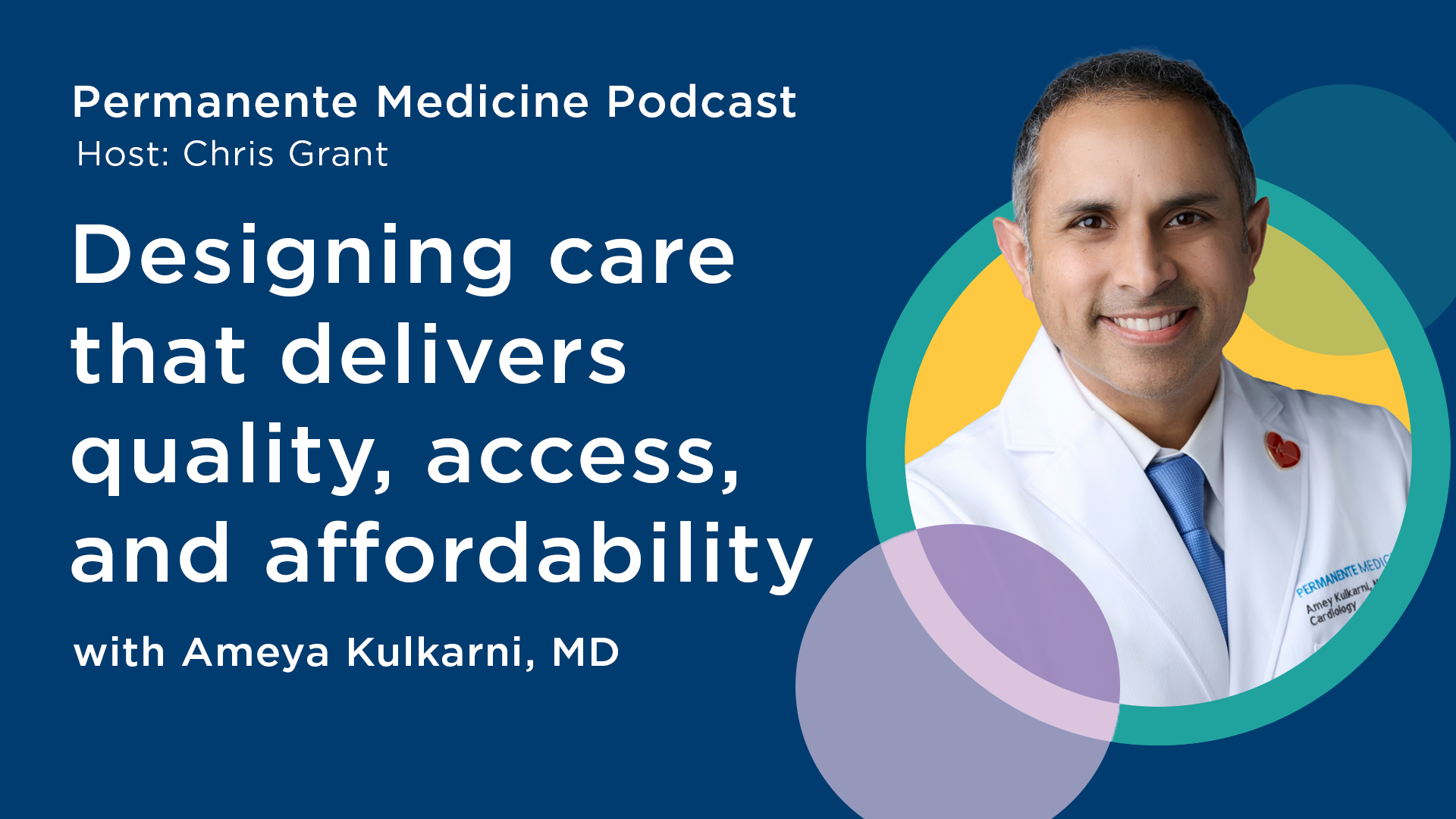
A conversation with Ameya Kulkarni, MD, on quality, access, and affordability in health care, and why the future of medicine at hinges on physician-patient trust.
Inside Hawaii’s community-driven approach to health care


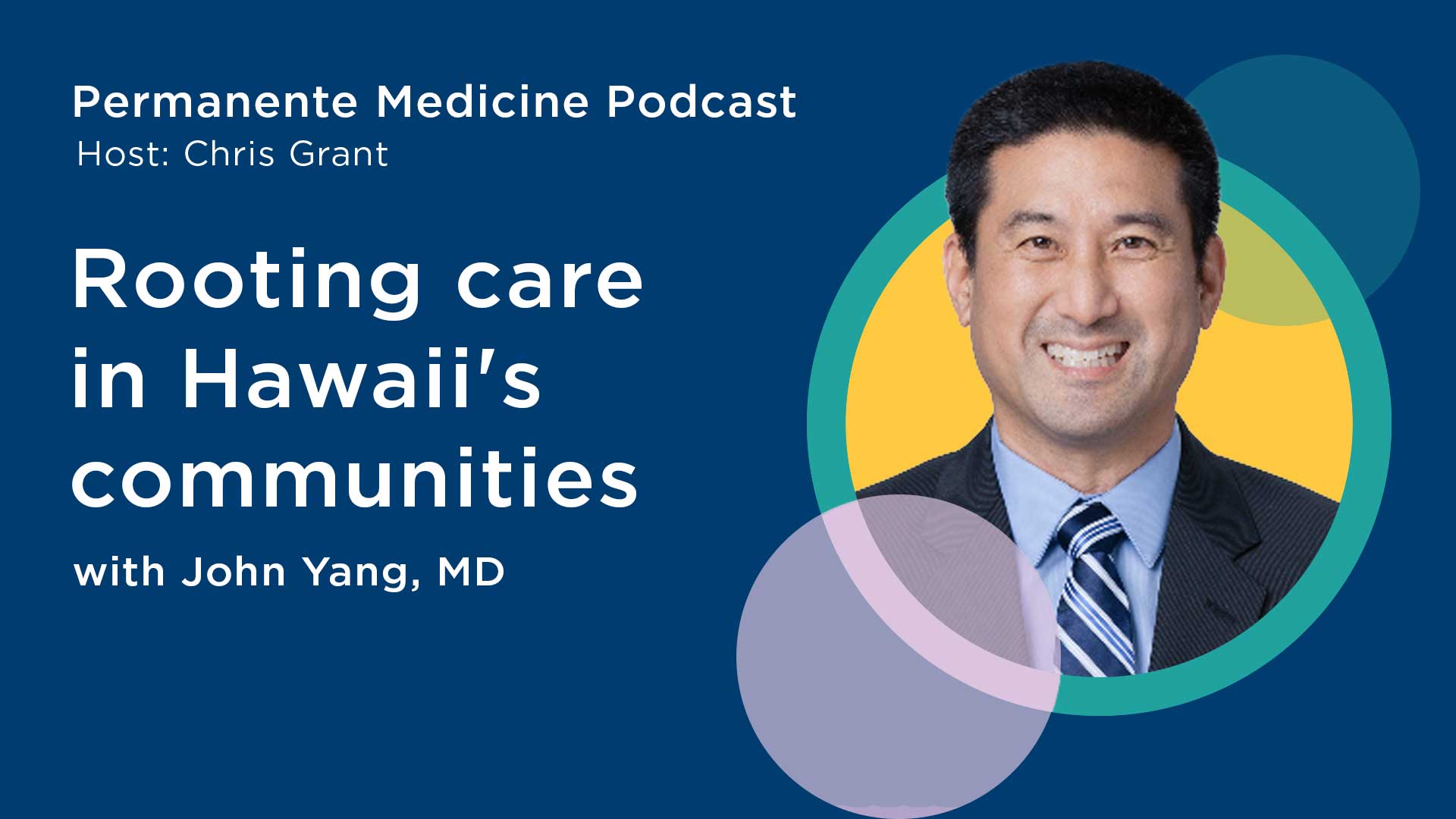
Rooting care in Hawaii’s communities: A conversation with John Yang, MD



In this episode of the Permanente Medicine Podcast, host Chris Grant sits down with John Yang, MD, president and medical director of the Hawaii Permanente Medical Group (HPMG), to explore the unique culture and community-oriented approach to health care delivery in Hawaii.
As the leader of the state’s largest physician-led multi-specialty practice, Dr. Yang explores the geographic, demographic, and public health challenges of delivering care across the Hawaiian islands. The conversation digs into how HPMG has leveraged health care innovations to overcome access barriers across the islands.
Listeners will learn how deep community ties help build the trust needed to effectively support communities during natural disasters, like the devastating Lahaina wildfires. The episode highlights how cultivating deep community relationships and cultural understanding drives better patient outcomes both in the exam room and beyond.
Dr. Yang also discusses HPMG’s proactive efforts to build a sustainable physician workforce, including growing their own talent through local training programs and providing robust support for clinician wellbeing.
Watch the full episode on YouTube:
Connect with Chris Grant by following him on X at @cmgrant or LinkedIn.
Follow us: Subscribe to the Permanente Medicine Podcast on your favorite streaming platform.
Podcast transcript
Transcript is autogenerated. Although edited for clarity, it should not be considered an exact replication of the podcast and may also be updated as needed.
John Yang, MD: The culture here is very much relationships. It’s about getting together. It’s important to invest in these relationships before problems arise. I think as we try to get groups together when there’s a crisis, if we don’t have that foundational relationship, then the trust is not there and we’re not able to work through things as effectively.
Chris Grant: Welcome to the Permanente Medicine Podcast. I’m your host, Chris Grant, the chief operating officer of The Permanente Federation at Kaiser Permanente. Today, I’m joined by a dear friend, Dr. John Yang, president and medical director of the Hawaii Permanente Medical Group. He leads the state’s largest physician-led multi-specialty practice with more than 700 physicians and clinicians providing care for 270,000 members across the state. From its geography and landscape, diverse population, and health needs, Hawaii is a unique health care environment. Today, we’re excited to explore the challenges and opportunities of practicing medicine in Hawaii at the community level and across the state. I’m really excited about this conversation because when we were together recently in Washington, D.C., meeting with congressional leaders to talk about Permanente Medicine and value-based care, I was so impressed with how you, Dr. Yang, shared our Hawaii story. And I know the policymakers were too. So now it’s time to turn to our audience and help them learn about your amazing work. Welcome and mahalo.
JY: Thank you. Thanks for having me. Excited to be here today.
CG: All right, let’s dive in. Before we get too deep into the conversation, John, tell us a bit about your journey into medicine and what ultimately drew you into medical leadership.
JY: So I was born and raised in Southern California, left California for about 8 years for medical school, for my family medicine training. Did a one-year fellowship in faculty development and medical informatics, and then ultimately returned to Southern California. I joined SCPMG in Orange County in 2001. I also always had an interest in technology from building my own computers to doing that medical informatics fellowship. And around this time, there was lots of discussion around the promise and the future of electronic health records. I feel like in some ways I got into leadership by accident. I always had a desire to make things better, improve processes, workflows. I would tend to ask a lot of questions and really be willing to try new things. And as I look back now, and I think a couple of experiences really helped shape the foundation of my leadership journey in addition to the many mentors that we all have that shape us personally.
Taking on a role as the physician-in-charge in a large multi-specialty clinic in Orange County, that was the foundation of helping me understand clinical operations, and it was also the foundation of the value and importance of a physician-led medical group. I was leading primary care in Orange County, but had this unique opportunity to come to Hawaii in 2020 in the midst of COVID. Very challenging time, lots of unknowns. But as I reflect back, super proud of our being a part of the state of Hawaii’s outstanding COVID response. Hawaii managed that pandemic highly effectively. We had some really unique things that we’re super proud of. We achieved the lowest age-adjusted COVID-19 death rate in the US, the lowest rate of excess mortality, all in the middle of the ocean in a place that didn’t always have all of the resources that other places have. Thinking back on why the state was so successful, I think a lot of combination of things, but things that mattered, rapid geographic containment, swift policy interventions, high vaccine compliance, and something that we didn’t see everywhere else was a deep community cooperation.
I’ll leave you with one fact that I think is pretty impressive that KP Hawaii delivered over a million doses of COVID vaccine. I’m pretty remarkable when you consider the population of Hawaii is about 1.4 million.
The importance of trust and cultural understanding in practicing medicine
CG: That is amazing. It’s delivering vaccines to 70, 80% of the entire state. It all makes sense to me of why you’re so successful in Hawaii because Hawaii is so relationally oriented and understanding people and building trust is really what it’s all about. What a heroic situation to dive into, to relocate to Hawaii, to one of the most isolated places of geographic concentration on the globe, and to be very responsible for the COVID response, not just to the Kaiser Permanente members and patients, but to the entire population. Speaking of culture and diversity, Hawaii is a diverse place that’s very distinct from other regions of the country. Can you talk a bit about the importance of connection and trust in practicing medicine in a place like Hawaii?
JY: For sure. It doesn’t take long for people to be connected by just a couple of degrees of separation. And what I learned very quickly coming to Hawaii that for so many that health care isn’t just a profession, it really is very personal. We’re caring for neighbors and classmates and teachers and family members. I know that happens everywhere to a degree, but it really happens here in Hawaii. Some statistics that are interesting, Hawaii’s ranked 40th in terms of state population, but I think because of the island state and also because the island of Hawaii is broken up into multiple islands, making those communities even smaller. Folks feel a ton of accountability to each other. Going back to the trust and the relationships are essential to so much of what we do, but they’re especially essential to effective care delivery here on the islands. I know moving from California that I know it takes time for folks from outside of Hawaii to earn and build that trust.
And as a medical group, we spend a great deal of effort onboarding, acculturating our new physicians and clinicians who join us from outside of the state to ensure that they’re successful here. Cultural humility really matters here. Understanding local values, family structures, so many multi-generational households, understanding those traditions aren’t just important. They actually improve outcomes. Our doctors, our physicians, our clinicians are often leaders in the community. They’re not just physicians and clinicians here. Many of our physicians will hold important, valuable, and multiple roles in community organizations.
CG: Every time I have worked in Hawaii and visited members of your team, I understand the connection that they have with the community. And in fact, there’s often stories about school groups, religious groups, community groups, and philanthropic that they’re deeply involved in and that they care about. And it’s far beyond, here’s my patient panel, and it’s all about here is my community that I serve, and that I’m so deeply committed to serving. And every time I leave Hawaii, I leave with a lot of learning. On that note, is there a lesson in community connection that you’ve discovered that might be helpful? We have an audience of physicians and leaders from across the country that might be helpful for them in other parts of the country.
JY: I think some of these things work everywhere, but I think in Hawaii it’s maybe even more valuable and important. The culture here is very much relationships. It’s about getting together. It’s important to invest in these relationships before problems arise. I think as we try to get groups together when there’s a crisis, if we don’t have that foundational relationship, then the trust is not there and we’re not able to work through things as effectively. So we’ve seen the value of that investment upfront sometimes when you don’t even think you need that investment or that relationship just yet.
As an organization, KP Hawaii, and especially within the medical group of HPMG, we spend a lot of energy and effort to bring people together and bring people together in person. We bring them together proactively to create these stronger connections. Even though it’s a small place because we’re separated by water, not all of our team gets to interact with each other on a regular basis.
So we make a point of investing in that as an important foundation for our trust and our accountability to each other. I mean, all of this is super critical in a Permanente model where really exceptional care requires interdisciplinary skills, it requires coordination across multiple specialties, inpatient, outpatient. And I will say listening, understanding what’s happening, following through on your commitments, not just hearing what people are saying, but actually listening and following through on what you commit to are often more important than necessarily having the perfect solution.
Strategies for taking on physician shortages
CG: And I hope our listeners are listening and just that conscientiousness of those steps and those tools is really quite important. Fostering a supportive environment for physicians is a key part of maintaining the workforce that delivers quality care to the communities we serve like Hawaii. And I don’t think I’ve been on a flight or met somebody that was visiting Hawaii that happened to be a physician where I don’t get to know them and actually try to recruit them when I like them into HPMG because I really do believe it’s one of the best places in the entire country to practice. Could you talk about some of the ways the Hawaii Permanente Medical Group works to attract and retain physicians?
JY: It may be a little bit of an unknown fact, but Hawaii faces the worst physician workforce shortage in the country. Sounds very obvious, but visiting and traveling here is very different from living and working here. One thing you’ll find is that our people tend to wear many hats. So people who are comfortable wearing several hats do well. Geography creates a lot of its own unique challenges from limited local training pipelines, distance from professional as well as family networks for our recruits, high cost of living, and all of those things are challenging in Hawaii as a whole, but even more challenging as we get out to our neighbor islands. And some of the work that we’ve done over the last 5 to 10 years that is bringing some long-term success is really a strategy to grow our own where it makes sense. Seeking recruits with some connection to Hawaii tends to make a difference.
We’ve done a lot supporting local students, career shadowing opportunities. We’ve got a key partnership with the medical school here on the island, the University of Hawaii, John A. Burns School of Medicine. A little bit more than 10 years ago, we created an internal medicine residency program that’s been very successful for us. And then just looking for pathways for physicians to return home, either through mentorship, other relationships has also been very vital and critical for us. As I think a little bit about retention, which is the other half of the recruitment, trying to understand why physicians stay. As I’ve witnessed as part of this medical group, it’s really the culture, the purpose, a strong sense of collegiality and connection outside of the usual stuff around compensation, but certainly not the only factor. As a group, we spend a lot of time and investment on physician wellbeing. We have a program that we call SELF CARE that’s very diverse and supportive of our physicians and clinicians.
We spend a lot of energy trying to reduce the administrative burden on them and let them be doctors and physicians and clinicians. And ultimately, I really believe the best recruitment strategy is creating an environment where physicians want to build a life and not just take a job.
Health care innovations overcoming Hawaii’s barriers to access
CG: And for all of our physicians or soon-to-be residency graduates, you heard it here first that there’s a high degree of support and collegiality, wellness programs, and a deep commitment to culture and community that exists in HPMG. And I know it’s way beyond words because I’ve witnessed it, John, under your leadership and with the leadership of the medical group, how deeply committed the group is to each other and to really creating a family. I’m going to move us forward here to talk a bit about access to care through innovation. As we all know, access to preventative care like screening and early detection is vital to improving outcomes and ultimately keeping care affordable. Can you discuss some of the specific barriers to access that are present in local communities and underserved populations? And related to that, what initiatives or innovative digital health tools are you excited about using to overcome some of those barriers?
JY: In many ways, I will say our geography forces us to innovate. We can’t be everywhere. And so I will say innovation’s not optional for us in a way. It’s really how we can ensure patients get access to care regardless of which island they call home. I think being part of a value-based organization allows us to do this in ways that make sense for patients and for our organization and not always have to be driven by how we’re reimbursed. So I think if anybody is set to be able to do this well and do it right, it is an organization like Kaiser Permanente. Things that are pretty normal now, I think we were maybe more on the forefront of pre-COVID, but obviously virtual care, video visits, telehealth, remote patient monitoring, and really any digital tools that help bridge distance. For us, it’s not just innovating for technology’s sake.
It really is with the lens of improving access to people that might be very far away from the expertise that’s needed. Some of the examples I think are pretty commonplace now are virtual specialty consultations. It’s very challenging to have every specialty available physically on all of our islands. Our rural communities are tough to get to, so we do a lot with remote care, remote patient monitoring, anything that allows us to reduce travel for our patients, which can be a barrier, or for our physicians to get out to the different islands, that can impact access as well. And then I think another area that we’ve tried to be really innovative with in a different way is just culturally responsive approaches to care. One of our really proud foundations is our newest West Oahu medical office, and it’s the only Kaiser Permanente facility in the program with a taro garden.
This is a garden that our people are out regularly harvesting and then providing that resource to patients in the communities.
Building care delivery connections before disasters hit
CG: I’ve had the privilege of visiting that garden and working that field alongside you, and it’s an amazing connection to the community and a demonstration of HPMG and Kaiser Permanente’s linkage to the local community. Hawaii has faced serious natural disasters in recent years from fires and flooding to annual threats of hurricanes. I think we have it tough in California. And then I look at Hawaii and what you have dealt with and led through. From a system-wide operations perspective, could you talk about the role Kaiser Permanente played in responding to these many challenges?
JY: Sure, Chris. And just for the record, it’s not a competition for any one of us wanting to be number one in natural disasters, but they are a very real part of life here. And like you mentioned it, hurricanes, flooding, volcanic activity, wildfires, tsunami threats. These aren’t things that might happen. These are all things that have happened and they’ve all happened relatively recently. I think one that most people remember from the very recent past was the Lahaina wildfires. And I will say this level of community trust is especially important during these crises and disasters and public health challenges. And during these Lahaina wildfires, I will say a lot of pride with our ability to respond what I think was very effectively, but I think we were able to do that because of the investment upfront. Our Maui teams had a strong relational culture. They wanted to be on the front lines of care that we were providing immediately after the fires.
Our Oahu teams backed them up for the other clinical work. And I will say this was also a demonstration of amazing support from our Kaiser Permanente enterprise in so many ways. Disaster planning’s more than just about us. This is coordination across multiple health care delivery systems. We had to work with the government, community organization, emergency responders. And I know firsthand if we didn’t have that relationship and trust built beforehand, and I think a lot of that we built during the COVID pandemic, I don’t think we would’ve been as successful in our response. But because we had those relationships, we had that trust, they knew that we were helping for the right reasons, that allowed people to let their guard down and let us in to help them in a way that if we had just come in during the crisis and the wildfires, they may have been more cautious or suspicious of why we were helping.
CG: It comes back to your earlier comments about relationships and building trust in the community long before there’s issues or challenges so that you can work through and really be effective. And I’m always in awe at the positivity and respect in the community in Hawaii that Kaiser Permanente holds. People love the organization, and they also often have a family member that they tell me about that’s a physical therapist or a nurse or a doctor, and they’re very proud of that. Staying in line with responding to natural disasters, it’s not just the community that’s affected, but it’s also the workforce. And I wanted to get a bit of your insight, John, on how you go about preparing physicians, all of our clinicians for disasters on both a personal and a professional level.
JY: It is a very real thing, this idea of workforce resilience and how important it is. As you mentioned, our caregivers are often disaster victims themselves. The health system isn’t just responding to the community, but we’re literally in and a part of those communities. And we had physicians, clinicians, we had staff lose homes in the Lahaina fires, and we mobilized to support them. KP also did something very innovative on Maui, I think people should be aware of, helping to sponsor health care workforce housing on the island. And been an exciting moment, one of our physicians who lost his home in the Lahaina Fires was actually one of the first to be able to live in one of those homes.
The future of health care in Hawaii
CG: Digging deep into that crystal ball, Dr. Yang, what excites you the most about the future of care in general, but also its impact on Hawaii?
JY: After years of seeing both the positive and the challenging impacts of the electronic health record, I’m really excited that technology that enhances rather than replaces, especially that primary care physician-patient relationship. In our organization, we’ve seen how various forms of AI have been fairly quickly implemented and seeing some really positive movement in reducing the administrative burden on our physicians and clinicians with charting, hearing from our physicians that they feel like their attention and focus and time are turned back towards patient care. Lots of technology in other innovations in our specialty, surgical specialties, our surgeons and other specialists are able to do more now with less impact on our patient. A few things that we’ve got in place in Hawaii in the last couple of years, but we’ve really had some amazing advancements and tools that allow us to biopsy parts of the lungs that traditionally were either difficult or impossible to reach.
We’re seeing more complex vascular procedures with advances in fluoroscopy technology. Robotic surgeries just become a part of the way we do business. Our robotic surgeons continue to discover new ways to use our robots at the Moanalua Medical Center, doing procedures that nobody else is able to do here in Hawaii. Another part that I think we have to keep paying attention to besides the technology, but the future workforce, the next generation of physicians, they’re going through one of these sea changes in terms of what people expect out of their physicians. So continuing to invest and develop the next generation of physicians, really investing in creating sustainable practice environments. Super important, especially here in Hawaii where we already have a huge physician shortage. And if people are retiring early because the work is not sustainable, we continue to lose people and worsen that physician shortage problem. Ultimately, I would say what excites me the most is this possibility of giving physicians more time to do what drew them into medicine in the first place, ultimately caring for patients.
CG: That’s beautiful. And I think that is the promise of technology in many ways. And some of the early adoption of electronic medical records and advanced technology probably complicated physicians’ engagement with patients. It might’ve helped from a technical perspective, but the actual kind of face-to-face environment. And now I think the evolution of technology, as you’ve pointed out, whether it’s ubiquitous listening and documentation or advanced diagnostic data analytics capabilities, it just gives more time for that physician to be the mentor, to be the coach, the motivator to that patient that they care so deeply about. John, I can’t tell you how glad I am that when you were called upon in the depths of a pandemic to move yourself and your family to a small island out in the Pacific, that you raised your hand and said yes, because not only are 270,000 patients and members benefiting, but all of the Hawaiian islands.
Your leadership and the team that exists in Hawaii is nothing short of phenomenal. And your informatics background and your understanding of technology allow even one of the most remote and sometimes rural parts of health care to be one of the earliest adopters of some of the most advanced technology. And it’s a combination of creating the right culture and having the right insight. So I thank you for your leadership and for saying yes because it changed the lives of really so many people.
JY: I just want to thank the many people that have supported both myself on a leadership journey as well as the affiliation between Southern California and the Hawaii regions. Our Southern California leadership team has been incredible, very supportive there when we need them, but allowing us to do what is right for the population here in Hawaii. And I have to thank the Hawaii team. It really has been my honor and privilege to be able to serve as the president and medical director for the last five going on 6 years. They really welcomed me with open arms and outsider from California who they occasionally make fun of and force to pronounce difficult Hawaiian words, but I also know that they have embraced me and I couldn’t have done this job without them.
CG: It’s so important that we learn about the diverse stories and health care challenges of the people and practices we serve. There’s always valuable lessons of how value-based care across all of our regions works, and this conversation was no exception. I want to thank you for sharing your insights and for the work you and your team are doing to care for the communities across Hawaii. And I want to thank our listeners to the Permanente Medicine Podcast for tuning in. If you enjoyed this episode, be sure to subscribe, share with your colleagues, and stay tuned for more conversations with physicians and other great leaders shaping the future of health care. Until next time, I’m Chris Grant. Thanks for listening.
The opinions expressed on this podcast are those of the speakers and are not necessarily the views of Kaiser Permanente, the Permanente Medical Groups, or the Permanente Federation.
Related Posts