Permanente Medical Groups led the U.S. in 2025 HEDIS rankings for preventive care, specialty care, chronic care, and behavioral health care.
Why access to pediatric care matters — and how Kaiser Permanente leads the way


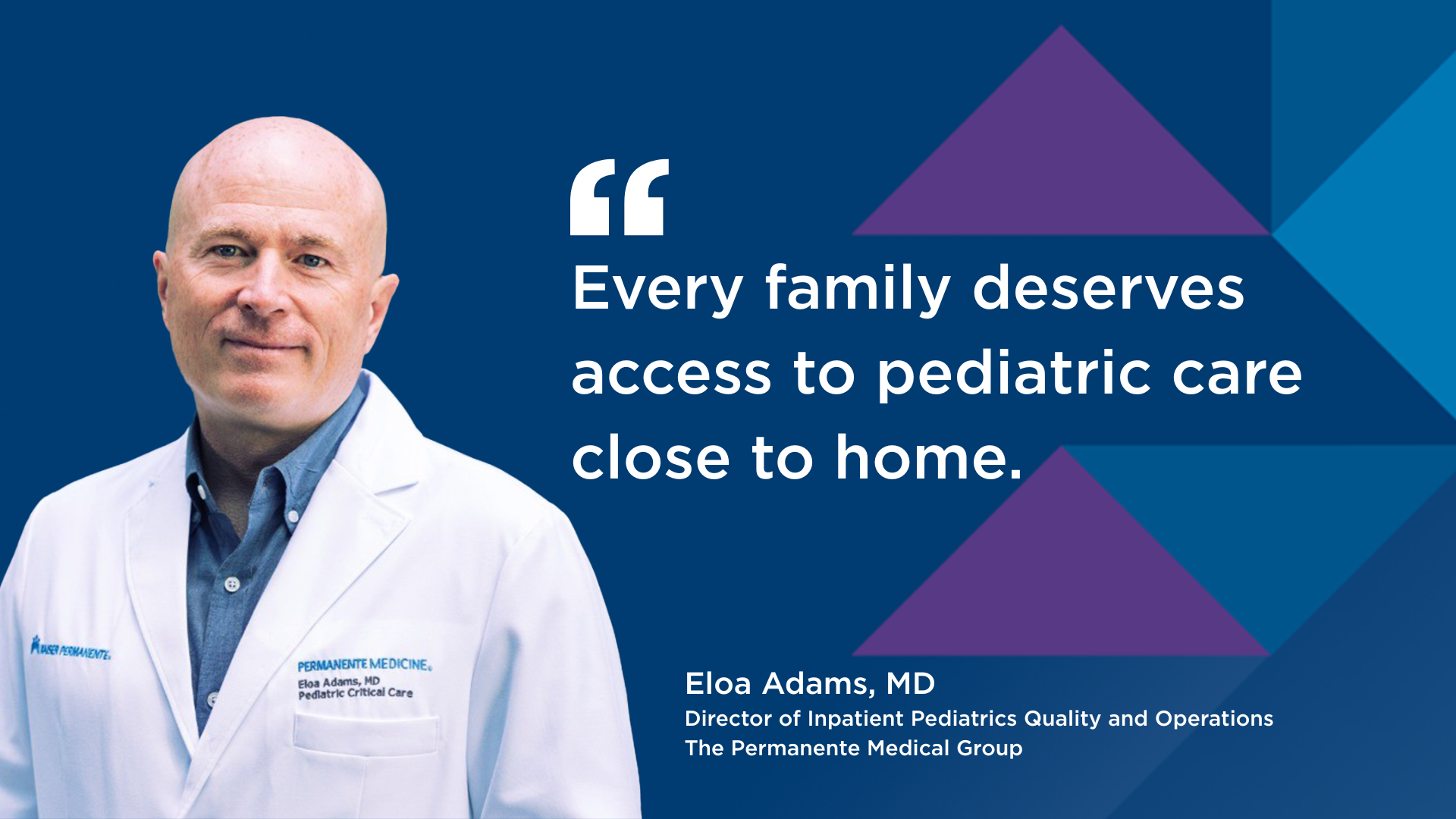
Eloa Adams, MD
Note: To learn more about how Kaiser Permanente is leading the way in dedicated pediatric care, check out our PermanenteDocs Chat episode featuring Dr. Eloa Adams.
Living in the San Francisco Bay Area, I know that I’m never far from the care my children might need. There’s no shortage of doctors and hospitals that specialize in pediatrics. It’s easy to take that for granted in large urban areas like my own — but it’s far from the reality many parents face.
The state of pediatric care becomes clearer to me when my family and I travel outside of our metro area. I will never forget driving to our first camping trip with my young son when it hit me: if something happened to him, we would be hours away from pediatric care. I felt incredibly vulnerable, but what choice did I have? I think that is a common realization that parents experience.
Limited access to pediatric care is not a new challenge, but it is growing. Pediatric care has been rapidly consolidating for the past decade. Many of these services simply aren’t as profitable as those for adults, and for many community hospitals, shifting pediatric care to children’s hospitals makes financial sense. While it’s true that our nation’s children’s hospitals deliver some of the highest-quality care families can find, consolidation is leaving many further away from care when they need it.
How value-based care strengthens pediatric medicine
Caring for children is not like caring for adults. Young people have physiology that demands different approaches unique to their needs. Whether it’s primary care or emergency services, it is always best for a pediatric patient to have a pediatric specialist.
Children and parents deserve access to pediatric care within their communities, and I’m proud to say that I work for an organization that prioritizes providing it. Kaiser Permanente has a long history of commitment to pediatric care: for more than half a century, we have invested in improving the services we offer, from neonatal care to our pediatric intensive care units.
What enables us to do this, ultimately, is the commitment to value-based care that is intrinsic to Permanente Medicine. Under a value-based model, we’re incentivized to improve the services we offer, including pediatrics. Similarly, being an integrated health system positions us to offer a greater breadth of services across a community via different care locations and collaborative teams that support patients on their care journeys.
What all of this translates to is better care for our younger patients. It means access to specialists when needed. It means quick and coordinated transport between care sites. And it means enabling unique initiatives to innovate our approach to medicine.
Take, for example, a group of physicians in Kaiser Permanente Northern California who are developing new strategies to reduce pediatric sepsis — an incredibly dangerous, yet preventable disease. They’re guided by a powerful motto: “More awareness equals more birthdays.” With this as their North Star, they meet regularly to discuss new ways to prevent sepsis infections in our younger patients. They’ve created new protocols and decision frameworks and are now leading national collaborations with Kaiser Permanente groups in Southern California, Hawaii, and the northwestern United States.
A path to stronger pediatric access nationwide
Value-based care has facilitated better pediatric care throughout Kaiser Permanente — and it can do the same thing in communities across the country. As our broader health care system continues moving toward this model, hospitals and other providers will have more freedom to prioritize pediatric care and prevent further spread of care deserts in their communities.
The need is definitely there. A July 2025 JAMA study found that children in the U.S. fare worse than kids in other high-income countries in key health measures. Chronic conditions like obesity, mental health issues, and developmental disorders have climbed 15 to 20% over the past decade. Infants here are nearly twice as likely to die before their first birthday, and children and teenagers ages 1 to 19 face almost double the risk of death.
There is clearly work to be done to restore and improve access to pediatric care in the communities that are left without dedicated resources like hospitals — children and families deserve that. We at Kaiser Permanente remain committed to providing that care wherever we can and advocating for the transition to value-based care broadly to support other health care systems in the same mission.
I’m proud to be a Permanente physician because we are aligned with the first priority of our members: their health. When they’re doing well, so do we.
Eloa Adams, MD, is director of Inpatient Pediatrics Quality and Operations at The Permanente Medical Group.
Related Posts