Discover what truly adds value in digital health and AI. Experts discuss ambient AI, chronic disease tools, ROI, policy, and how leaders choose safe, effective innovations.
Why physician trust matters more than ever


The COVID-19 pandemic, misinformation, and shifting guidance have led to a significant erosion of trust in health care institutions, making it challenging for physicians to effectively communicate evidence-based information to patients. Physicians still maintain a high degree of trust with their individual patients, and have an opportunity to serve as ambassadors for science and evidence-based medicine in their communities.
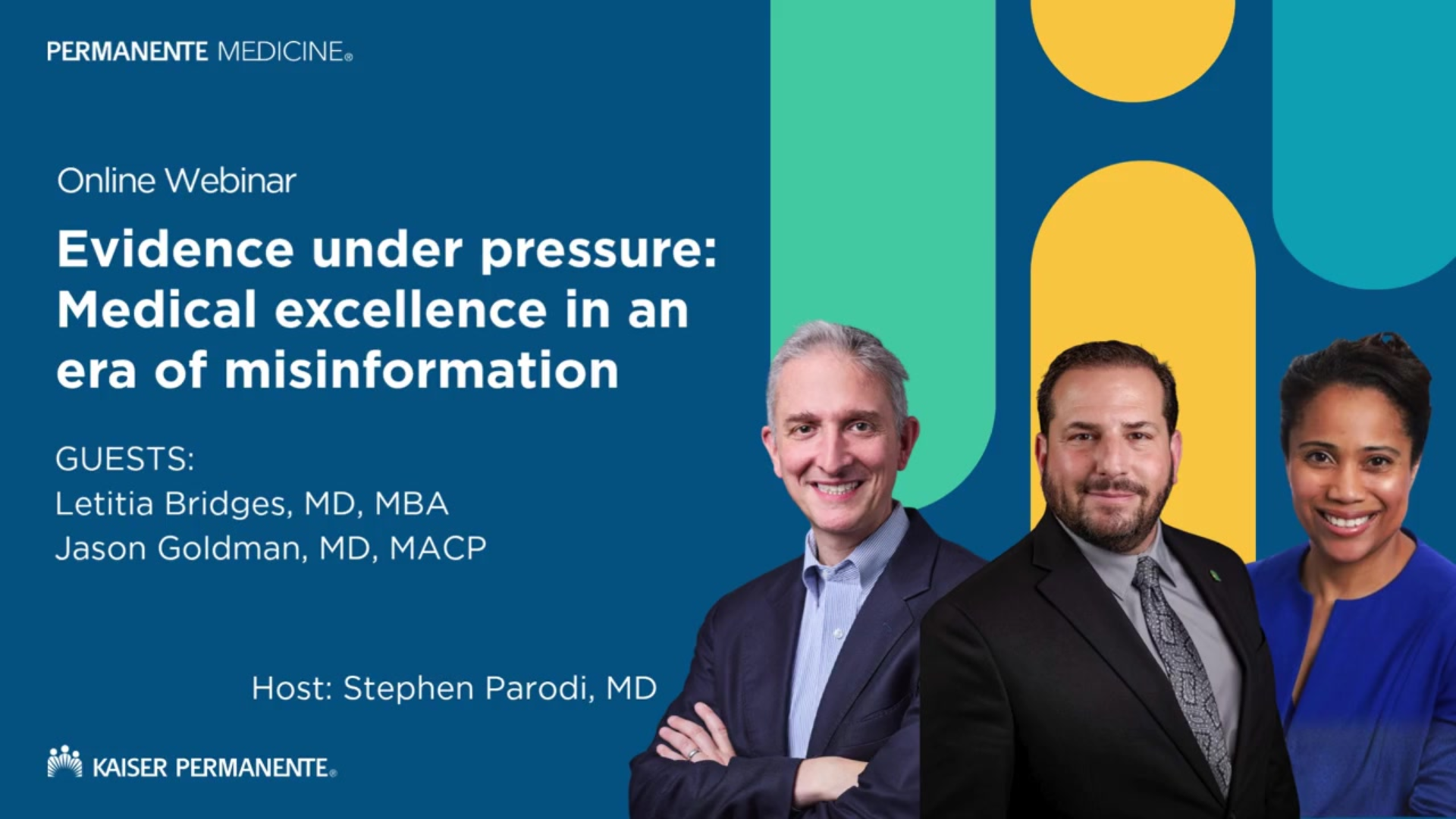
Hosted by Stephen Parodi, MD, executive vice president at The Permanente Federation and The Permanente Medical Group, this Permanente Live webinar explored insights from national leaders in health care:
- Jason M. Goldman, MD, MACP, immediate past president, American College of Physicians; internal medicine physician
- Letitia Bridges, MD, MBA, executive vice president and chief quality officer, The Permanente Federation
The conversation covered timely topics like:
- The challenge for physicians and patients that the environment of medical misinformation and mistrust in public institutions poses.
- The importance of physicians and health care organizations developing their own evidence-based guidelines and resources and engaging with the public beyond just the clinical setting, to help rebuild trust in expertise and evidence-based medicine.
- The need for physicians and health care leaders to prioritize safety and accuracy when evaluating AI and other new technologies.
- The value of strategies like open communication, acknowledging uncertainty, and actively listening to patients.
Podcast transcript
Transcript is autogenerated. Although edited for clarity, it should not be considered an exact replication of the podcast and may also be updated as needed.
Stephen Parodi, MD: Hello everyone and welcome to our Permanente Live webinar, Evidence Under Pressure: Medical Excellence in An Era of Misinformation. I’m Dr. Steve Parodi, executive vice president of the Permanente Federation and The Permanente Medical Group. And thank you for joining us today. I encourage you to amplify the conversation on social media using the hashtag #PermLiveLeadership. And as you listen to our discussion, please submit any questions using the Q&A function in this Zoom meeting. We’ll ask our guests your questions a little later. Accessibility and the nature of medical misinformation has been transforming over the last several decades. Information technology, social media, and artificial intelligence are all defining how an individual seeks answers to their medical questions. Professionals, patients, and policymakers are questioning the reliability and impartiality of sources they’ve long trusted. Replacing trust are the unwelcome elements of apprehension and suspicion between clinicians, patients, and families. Democratization of information on the other hand can level the playing field and lead to a more substantive conversation about clinical care and heightened ownership of a patient in their own health outcomes and health overall.
Beyond the day-to-day realities of our exam rooms and hospitals, changes to federal agencies have led to some to question the scientific guidance issued from these time-honored institutions. The restructuring or wholesale dismissal of national expert-led committes and subsequent changes to policies pertinent to vaccines, preventive services, women’s health, and host of other topics have had far reaching real-world consequences. Increases in contagious diseases and maternal mortality are just some of the consequences we are wrestling with as a country. The impetus to respond has led to the rise of alternatives where our organizations are banding together to produce evidence-based guidelines due to what appears to be an existential threat to public health. And despite all of this upheaval, trust between doctors, nurses, and their patients remains high. People still actually value that deeply personal relationship. So thank you all for joining us because what’s a busy practicing physician supposed to do in this new world?
And to make sense of all of this, we are joined by two national experts. Dr. Jason Goldman is the immediate past president of the American College of Physicians and Dr. Tish Bridges is the chief quality officer at the Permanente Federation and co-chair of the Kaiser Permanente National Quality Committee. What does it mean to deliver high quality care while maintaining trust and credibility in a highly partisan environment? How can public institutions still support the dissemination of evidence-based medicine and information? What needs to look different? Jason and Tish, thank you for joining us today. Jason, I’m going to turn to you first and maybe help level set this whole conversation. So federal guidelines have shifted and many physicians seem to be more concerned about the decisions that are being made right now and the evidence that they’re based on. So what’s different about this environment and are these concerns valid?
Jason Goldman, MD, MACP: That’s an excellent question. First, thank you for having me. This is an absolute pleasure to participate in this forum. It is very concerning what has happened to our entire public health infrastructure and the policies and the stance that has been created and how things are changing. We used to look at our institutions. We used to look at policy committees, public health committees as sacrosanct and they gave the information these were our guidelines. We could trust them. We had the evidence and that would shape how we as physicians are able to take care of our patients, what we can fall back on, how we can look at that information, make the best possible recommendations. We’ve entered this era where there’s so much mistrust, misinformation and challenge to the very fundamentals and foundation of our public health infrastructure that it’s very difficult to know what guidance we can rely on, where can we turn to and how we can best take care of our patients.
And it affects not just us as physicians and having those guidance, but also our patients because they’re getting mixed messages. And when they come into the exam room and they ask us for our opinion, they’ll turn around and say, “Well, we have other opinions from other doctors who are saying the exact opposite.” So it makes it very challenging for who the patients can trust. You are right, there is that initial [edit] or that still the foundation that the patients want to trust their personal physician, but they’re being inundated by so many different sources from so many other sides making it very challenging in this environment to get the information out there to the patients where it needs to be and for them to have a trusted voice.
SP: Thank you, Jason. Tish, what are you hearing directly from practicing physicians? How are these changes actually affecting them, to Jason’s point? The inundation of all the information coming in, whether it’s on social media, whether it’s your own patients, whether it’s Dr. Google, and it’s no longer Dr. Google, it’s Dr. AI. So what do you think about all of that?
Letitia Bridges, MD, MBA: Great question. And again, thank you for facilitating this conversation. It is a vital one I think for all practicing physicians. What physicians are feeling now is frustration with not conversations that are new that really reveal a lot of the challenges that they’re experiencing in the external marketplace, but they’re really feeling this uncertainty themselves around what is the evidence, how is it accurate, how is it evolving, and how do I bring that into my practice from one day into the next? And so as I’m traveling the KP enterprise and talking to various physicians, there are deep concerns about sources that they’ve always trusted. And I think Dr. Goldman hit on this beautifully. We have come to learn that the USPSTF is a source of guidance for us. We’ve come to rely on what comes out of the FDA and there was a natural trust there that information coming out of these alphabet soup agencies were really that it was reliable.
And I think the unsettling feeling here is just the uncertainty as we step into the clinical practice arena. I’ll share a really interesting story from one physician who is racing to care for patients, but is also really attempting to be very diligent in keeping up with his ongoing education. And he asked me a couple of weeks ago, “Well, can I still trust this source?” And I said, “Well, yes, that’s still a trusted source.” And he said, “Well, how do I know? I mean, I can’t trust anything anymore. The ground is constantly shifting beneath me.” And what we talked about was really this opportunity as physicians to continue to step into this space to really deeply understand what we’re managing towards and at least within Kaiser Permanente to lean upon the systems that we’ve already launched. We spend a little bit of time talking also through how we evaluate evidence within our own enterprise and how that shows up in our clinical practice.
And so really at this time, I think the opportunity for us is to not only to continue our national advocacy, we need to really be involved in these spaces, but we also should be thinking heavily about how we get involved with evidence synthesis conversations within our own specialties, how much attention we’re paying to our own medical societies and understanding and living the standards, but then also the clinical practice guidelines that we are developing together, we all need to have the opportunity to be into those conversations and to build them into the EMR, to build it into the conversations and to use that clinical knowledge that we have internally vetted to really drive the care that we deliver.
SP: Tish, I really appreciate what you just said. And as I think about this, Jason, Kaiser Permanente, we actually have a clinical library, it actually is maintained by physicians, physician leaders, experts, researchers, and we modify it and update it. And of course it’s directed towards our clinical practice and value-based care. We’ve had to modify it recently. So a lot of the evidence to Dr. Bridges’ point here in terms of the physicians are saying, “Well, wait a second, can I trust X, Y, or Z federal agency?” And you referenced it in your clinical library. In fact, we’ve modified it and I’ll cite ACP is sometimes now being substituted for some of these other named agencies What’s happening nationwide? Is that just a phenomenon within Kaiser Permanente or is it broader?
JG: It definitely is a much broader conversation and it comes down to who can you trust? In the past, you trusted your physician, you understood they went to medical school, they got their degree and the weight of those letters, MD, DO, behind your name, came with that certain trust factor and acceptance that we all agreed these were experts, these were well-trained professionals. What we have lost is the acceptance of expertise. There’s a book written a while ago, The Death of Expertise. And the sad part is whether it’s the democratization of information or the internet or everyone can just find whatever they want and may or may not know how to interpret it, we no longer accept, [edit] or many people just no longer accept expertise for what it is and they question everything. So on one hand, we have lost that basic trust in just the simple conventions of who we can trust.
And that’s a shame because we no longer have that level playing field. So we then have to ask, “Well, who can you trust?” As you said, we look at the ACP. We’re one of the only, if not the only medical organization that is a GRADE and AGREE center, which means we have the highest level of standard for evidence review when we make our clinical guidelines. I think part of the problem when we look at our patients, when we communicate to the media, to the press and to the public at large is people don’t necessarily appreciate what that means and how we come up with our guidance. With that strict requirement for GRADE and AGREE, we have to have good foundational evidence in order to put out a policy paper. And if we don’t have evidence, then we may not be able to comment upon it because we can’t substantiate it, but absence of evidence does not mean evidence of absence.
We just may not be able to rely on a study that we have, but that doesn’t mean we aren’t trusted information and that has been lost to the public. In one of my other roles, I’m the ACP’s liaison to the Advisory Committee of Immunization Practices, which we all know has come under fire in the past year with vaccine recommendations, which caused ACP and several other organizations to step in and fill that gap by publishing our own vaccine guidelines. But one of the points I wanted to bring up is that many people don’t see, to use the vernacular, how the sausage is made. They don’t see the work that goes into the committees that we serve on to be able to come up with these guidelines and just how robust and in depth that evidence review is before its final presentation before the committee before a vote.
And in that absence of knowledge or people refusing to see how it’s done, they claim there’s no transparency and in the shadows or the gray area they say, “Well, you can’t trust them.” But if they actually looked and actually went in depth and saw the transparent processes that ACIP, ACP and other organizations use, they would say, “Oh, we can trust them because there is actually a standard transparent evidentiary process in how they came up with those conclusions.” And sadly, I think that is what is missing and what is being capitalized on is the innuendo and the gray areas that people are using to claim you can’t trust various agencies when in fact you can.
SP: So just a quick reminder to everybody, if you have questions, please submit them using the Q&A feature. And again, we’re going to try to get to all or as many of your questions as we possibly can. Tish, I was just listening to Jason here and I know a lot of the focus of misinformation has been related to patients and patient consumption, but it’s not restricted to just patients. It’s clinicians. And by the way, there’s a spectrum there. And so I’m interested, you represent an organization that has 25,000 physicians and there is a vast diversity amongst that population in terms of the consumption of this information, the interpretation and then actually application of it. What do we do and how are you tackling it as the chief quality leader within a big organization?
LB: So thank you for the question. And it does very much link with the conversation that Dr. Goldman was just taking us through and I will answer the question in two ways. The first is our 25,000 physicians need to know how much our own research contributes to the evidence that sits out in the general public. I love to communicate with our physicians around our vaccine safety data link, for example. We actually produce the data that has been used by ACIP in order to determine the guidelines that we followed. And so within Kaiser Permanente, we have this incredible history of being active participants in the research that we need to deliver on our promise of public health. And so we start with that communication, but what’s really important is that as a physician, you will hear me loudly and often communicate two things. The first is policy has no role in the exam room.
In the exam room, it is “What is the evidence” and keeping us focused on what we are here to do, which is high-quality care that is accessible for all, that’s really the focus. And the way that we get to that value-based care is by delivering on the evidence. And our clinicians are excited about many new tools, the open evidence, the ChatGPT. I mean, there’s so many different frameworks that folks are using to find the evidence, but reminding them that we are diligent about building the tools into their clinical practice, bringing these tools through our CME infrastructure, also incredibly important lunchtime meetings, really pushing in on that education as a follow-on to the understanding of where the data comes from and how we participate in that. I think the combination of those two incredibly powerful. As we think about the physician group writ large, we do have the opportunity to continue these conversations.
And one of the valuable frameworks that you’re bringing actually is to just open up the dialogue between us and all facets of the government. I think the amount of engagement with government relations also powers a lot of the understanding so that folks can really start to understand what’s happening in the external environment. And in many ways it helps them to make sense of what they’re reading and what they’re seeing because our physicians really need to translate this for our patients and that translation really requires foundational knowledge. And so I would say those three pillars are really the core aspects of the approach to help our physicians navigate what has become a very difficult environment.
SP: Jason, thank you, Tish. I want to pull on a thread here and I’m going to reflect, maybe this is recent conversations that are guiding me here. So I was literally talking to our information technology leader yesterday about AI and the use of it within our clinical practices. And really the question was, “what kind of training do we need to be providing?” And there’s the spectrum of clinicians who hopefully they’re going to practice for 30 years. I think I’m looking at the two of you. I don’t think any of us had AI in our world when we were training and yet it is part and parcel to our practices now. And on top of that, you’ve got people coming up who that’s the world they’ve lived in. They trained in college and or med school and it’s natural to them. What do we need to be thinking about from a medical education perspective, whether that’s undergraduate, graduate and/or continuing medical education? How does ACP think about it? How should other specialty societies be thinking about it?
JG: I think about that a lot because it’s been an explosion overnight with AI just integrating into every aspect of our lives from medicine, the exam room to how we function on a day-to-day basis, how we communicate, whether we think it’s good, bad, or indifferent, it’s here and we need to face it. One of the things as physicians, we’ve all been taught to be critical thinkers. We have been trained to review studies, to look at data and evidence to question, to come up with our own conclusions, we need to apply that same critical thinking to everything we do, but we also have to balance that with implicit bias, which we all have and recognize what we’re leaning towards and how we’re filtering that data. When we look at artificial intelligence, for many people, physicians included, the natural reaction is you read it, it must be true, it cultivated sources, it’s saying that it has evidence so we just accept it at face value, but that’s where we have to be very careful.
And ACP is looking into policies on AI and how we best approach it and how we use it in practice. One of the things at least that the American College of Physicians has done is partnered with DynamedX, which does have AI, but it’s within a walled garden. So all of the data that it’s using is vetted and cultivated from ACP guidelines and policies and sources that are trusted. So it’s not going to hallucinate and pull out information from other places. So you have to know where you’re getting that AI information from, how does it filter the information and what is it using to be able to come up with its conclusions. Otherwise, you may run down a rabbit hole of wrong information and poor patient care. So it really comes down to applying the same critical thinking and standards that we do for everything in medicine from reviewing studies to differential diagnosis, to analyzing patients, to whatever our own Google or other research or DynaMedex or UpToDate or OpenAI or whatever is used and really apply that same critical thinking and skeptical lens to be able to make sure the information can be trusted.
LB: This is a fantastic topic. As we think about AI, the promise is certainly there and I agree it’s here. We’re actively using it and we really want to think about this through the lens of safety. We want this to be a tool that accelerates us. And as we all know, acceleration can be both positive and negative. And as we’re considering what we bring in, we need to understand how these tools are created, what data it’s trained on, and to your original question, how the physicians are prepared to evaluate the use of these tools. We talk a lot about keeping a human in the loop as it relates to this, particularly in care delivery decision-making, but there’s a few steps before that. And one of the big initiatives that we’ll be rolling out over the next several months here is that we will have active CME education for all of our physicians to help them both recognize the tools and to help our physicians understand what the tools are and what the risks will be in using those tools.
And so this is a critical area for us. And I would also say that our physician leaders that are operating in this space, they’re really learning and evolving and training differently, understanding how to read a data use agreement. That is not anything that any of us learned in medical school and yet it’s critically important for physicians to really feel comfortable at this intersection between clinical care and technology. And so for those of you on the call that are already in this space, I want to first of all applaud you, but I also want to challenge you to remain engaged and to bring everyone along. I think this is that next evolution that we probably haven’t had since we launched our EMR and our ability to integrate and to use this tool, to use this tool to design our systems to make it more efficient and effective for us, tremendous opportunity here and just very excited about what the future will bring as it relates to AI, as long as we’re thoughtful about the safety constructs and the governance that we put around it.
SP: All right, got some questions rolling in. I think you’ve generated some interest. All right, let me ask you the first question that I think is a little provocative. All right, the United States has often been a trusted source of information when it comes to medical information and leadership. Given what’s going on right now, what other sources should we be thinking about as physicians? Do we need to be looking at international sources, other places to get that information, or do we actually still have it in the US? We just need to look in different places.
JG: I’ll try and be parsimonious with my comments. This is an overused word, but these are unprecedented times. The fact that we see an active attack on science, on expertise, on our very evidence and reality in some cases is challenging. Yes, we do need to always be open-minded, look at other sources. When you look at European guidelines, when you look at the WHO, when you look at Canada, for example, and their guidance on different treatments, we need to have the same critical evidence review. We have to look at our medical organizations, the American College of Physicians and others, and use those as credible sources. It’s unfortunate that as I circling back to what I opened with, we can’t necessarily still trust what was sacrosanct because those institutions for political reasons have been compromised and it’s going to take generations, I fear, to get back to a place where we can have that trust again, but we really do need to rebuild that foundation.
And no matter what policy administration is in place, we need to have a consistent, transparent, evidence-based process that can always be turned to regardless of the political forces that are affecting them because you’re always entitled to your own opinion, but not your own facts. The facts don’t change, the evidence doesn’t change, and the process needs to be in place no matter what. So yes, we can and do need to look at other sources of information, but we also need to make sure we see the transparent evidence-based process in how those guidelines and policies and recommendations came to be.
LB: My perspective is that the federal government has rewritten how we should be thinking about our standards. It’s just that simple. They’ve pulled themselves out of the scientific conversation pushed into a policy space that does not serve the clinical practice needs for physicians in this country. And so the challenge and the opportunity is in this new world order, what should we build that actually gives us the evidence that we need? We’ve always been fantastic with scanning evidence sources both national and international. We have been fortunate for the last 60 years that we’ve had an infrastructure that we could trust, but before that, remember we did not. And so in many ways we have to go back to practices that we’ve had in the past, which is coalitions, which looking at international data, thinking about what it is that we need. And then as physicians, as a community of researchers, as a community of health systems, insurance companies, everyone that has a vested interest, we need to figure out what these new coalitions will look like moving forward and form our new infrastructure.
And I think this is exactly what Dr. Goldman was calling out. And so I would really beseech us to quite frankly accept that the government has stepped out of the trusted role that they have offered in the past and for us to spend much more time building what comes next that will be both resilient against any future policy infrastructure, but also facing the patients in a way that is deeply meaningful to the ethical practice of medicine.
SP: Tish, this next question actually pulls on a thread that Dr. Goldman had brought up earlier, which was in some ways he was raising the idea that actually the public policymaking amongst physicians is actually a time-honored tradition. It’s actually be good to be transparent about it. On the other hand, some of that transparency during the COVID era was not embraced. In fact, it was seen as uncertainty or confusion. And so I guess the question I’ve got here which relates to this is, are there lessons learned from the earthquake that we just went through for the last four and a half, five years when it came to COVID where there can be logical and reasonable evidence-based disagreements? And what should we doing as physicians to embrace that, amplify that, and also explain that in a way that is understandable to the general public? Is there anything that we’ve learned from our experience last five years?
JG: I co-authored an op-ed actually that was published in Annals basically saying lesons learned from COVID, flying the plane while building it. And one of the biggest issues is communication and explaining to the public and even to our own physicians, embracing the uncertainty. Science is an iterative process. We constantly are learning. We come up with a theory. We try to prove that theory, and if it proves not to be true, we move on to prove something else. We don’t try to keep re-litigating just because we want to believe something. We have to accept the evidence and also explain what we don’t know. And that is scary for many people to admit, I don’t know something, or we don’t have the evidence. And that was attempted to be done during the COVID pandemic, but it was such a chaotic time some of that messaging was lost.
So one of the biggest lessons is explaining to people what we know, what we don’t know, where we have gaps in evidence, where we need to learn more, and to say, “We’re unsure about this. We don’t have the answer. This is what we’re trying to find out. ” But that is applicable not only to the public, but also to our individual patients when we’re in the exam room. Say, “I don’t know what you have, but we’re going to try and figure it out, but we may not be able to, but this is what we’re going to do to try and get you better.” So it’s about clear, honest, open communication and admitting when you don’t know something.
LB: I love that response. And as we think about navigating the last five years, we’ve learned many things, but one of them is really just the deep discomfort in this country, quite frankly, with uncertainty and the need to create a polarized yes or no, black or white. And that’s not really the point and purpose of science. When we think about the scientific method, it really is about there’s a question we’re going to try to answer it. There’s this inquiry that’s built into it and there’s this willingness to evolve and to pivot and to move. And I think that as I think about lessons learned, it is comfort in moving in uncertainty and it is also a shared vision and purpose. What I loved about COVID was that we came together in ways that I had never seen before. We came together across hospital systems, across payer groups, across entities, kind of writ large.
We had a shared purpose and we were constantly and aggressively working towards that. And this latest crisis, I call it the crisis for lawyers because my perspective that it’s mostly the lawyers out there generating all of this. And we need to figure out how we can come together in order to resolve the policy crisis that I think we’re facing. And so when we think about COVID, science did save us. I don’t think that we say that out loud, but it is definitely true that the scientific process ultimately saved us from that latest crisis. And the same is also true of today, valuing the science, understanding and using the scientific process and convening together with a shared purpose. That’s the way out of this, quite frankly, and every other crisis that will come our way.
SP: So Tish, to follow up on that, because we’re talking to individual practicing clinicians here, what does someone need to do in the exam room in this new environment? I mean, there are just some cold, hard realities. I mean, I still treat infectious diseases. They still exist. Heat-related injury issues, climate-related issues are realities in our exam rooms, yet these have been politicized and/or subject to partisan discussion. And we all come with our various backgrounds by the way, whether it’s on the clinician side or patient side. So in that environment, what is the optimal aproach for a physician in this day and age when they’re having those conversations in the exam rooms? What’s Kaiser Permanente doing? Are we training people to talk about these conversations?
LB: Yeah, that’s a great conversation. At the end of the day, the patient-physician relationship is about trust. And in those exam rooms, as busy as we are, we have to sit with the discomfort of some of these really challenging conversations that we need to have. Patients are certainly coming in with deeply held beliefs that may or may not be rooted in science, that may or may not be rooted in common sense. And I think after the 15th conversation of the day, it is tempting to just throw your hands up and say whatever. I think this is the opportunity for us to really demonstrate who we are. And as a profession, we are people that deeply care about people, about our communities, about our country. And that has to be reflected in the conversations that we’re holding one-on-one and the willingness to share both sides of the conversation to hear what the patients are solving for.
I take particular interest in learning where they’ve received their information because the sources sometimes are quite amusing. But really this is about our ability to have those crucial conversations with patients and to have the resilience to do that on repeat mode. I will say that as an organization, we’re thinking through a couple of things. The first is really the use of motivational interviewing. It is incredibly empowering for physicians to sit with patients and to deeply understand what the patients are solving for. And I think that conversation takes us away from some of these dichotomous beliefs around clinical practice standards and really puts us back into the realm of how are we solving through your medical challenges together? What matters to you? How can I support you on that journey? And removing some of the friction from the communication that comes I think is a large part of the training that we’re taking on.
We also know that there’s an explosion of cognitive behavioral science that’s really helping us to learn to navigate some of these conversations differently. And I think we also need to take advantage of the longitudinal care that we have. Not all challenges can be solved within one visit. And how are the non-physicians really supporting these conversations? What does it look like at scale for the team to really support us as we’re moving forward in a very difficult space? Because this misinformation is not going away. I mean, it is deeply rooted and I love what Dr. Goldman said earlier. I do have the perspective that the environment that we’ve lived in in the last two years will be unsettling for us for decades to come. This is not about a four-year term. We have an entire system that needs to be rebuilt and we have to yet again in crisis lean on our physicians and really inspire them to continue the difficult conversations that exist out there.
And what I will say to wrap this little question is that I always remember sitting in that exam room that I’m not just talking to that patient. I’m talking to that patient who will interface with their husband, with their children, with their grandparents, with their best friends, with the people that they work with. And as physicians, we’re a little bit of a star. I mean, we have this energy that can radiate out across our patients into their environment and we can start to change the narrative one patient at a time even when we’re frontline physicians in the exam rooms.
SP: What an amazing comment to say that we are stars in our exam rooms. Thank you, Tish. So on that sort of note, Jason, I’m going to ask you both the same question here. What’s a concrete example that you’ve seen or heard from a physician leader that has successfully strengthened trust in their patients or their communities? So go broader than just the exam room itself that’s led to either greater belief in evidence-based care or an amplification of that. So Jason, I’m going to give you the first crack at that one.
JG: So I was thinking a lot about what Tish was saying and there’s definitely the movable middle that we talk to. There’s some on both sides of the spectrum which you will never reach. There are those who agree and then those who disagree, they’re each in their echo chamber. No matter how many conversations you have, no matter what approach you have, no matter what you do, they’re entrenched, they have their belief system, you’ll never break through. It’s really that movable middle who’s unsure, who wants more information, who is able to accept and receive new evidence that you can work with. I remember having a conversation with Dr. Ashish Jha and he gave an example where he had a patient discharging from the hospital and they had a great visit, took care of him. He had a heart problem, got him better. And upon discharge they were joking, laughing, great interactions.
And then, “Oh, by the way, have you gotten your flu shot?” And the conversation dramatically changed, the demeanor changed, and it became the, “Well, how much are you getting paid to give me that flu shot? What’s the bribery that you’re getting?” He’s like, “Really? Tell me more.” And so it’s that simple phrase, “Tell me more.” Because you’re engaging the patient, you want them to talk, you’re not berating them, you’re not saying, “Well, that’s ridiculous.” You’re not challenging them. And as the story went on, the patient’s like, “Well, the pharmaceutical industry’s paying you. ” Okay, how? Walk me through that process. How do you think that occurs? And when you start delving into it and the patient, you let them talk in the narrative, it’s like, okay, well, I kind of see you’re right. Maybe there’s no actual way to pay you and I’m not really sure how it happens, but that’s what I’ve heard, yet it kind of doesn’t make sense.
He still didn’t get his flu shot, but there was narrative, there was dialogue. So both on an individual as well as a global, it’s about active listening. It’s about the narrative. It’s about letting the patient or the individual or the public at large have that expression as long as they’re willing to listen in return. And that’s why it’s communication and it’s a give and take because the hammering, the beating down, the “you are wrong, you need to do this” it falls on deaf ears. And there’s some people, no matter what we do who will never listen, but for those who are willing and you engage with, okay, well, I’m trying to help you. Explain to me more so that I can help you better. And that really, for me, is a approach we can use in many aspects of our lives, not just the exam room, when engaging with someone who is not sure of how they can trust you, getting them to engage with you and being willing to listen to them.
SP: Thank you, Jason. And Tish, I’m going to probe you on top of this. So that question to you, but also is there a role for the physicians outside the exam room? Should we be doing podcasts like this? Should we be on social media? What else should we be doing? Or do we stay in our lane? And what is our lane?
LB: Well, I deeply believe that as a physician, we have both a role and responsibility outside of the clinical practice. And Dr. Goldman here leading the ACP, I mean, that is just an incredible example of how the shared vision that we have can actually be propagated across the country and even internationally. And so I would say a couple of things. The first is I love this idea of the movable middle. We’re always talking about do the work that can be done and be persistent with that and finding your shared purpose with the patient and really taking the time to explain it. I mean, that’s really valuable. I don’t know about you guys, but I’d love to know how the pharmaceutical companies are paying me. I’m missing those checks. But if that’s a narrative out there, we need to have the opportunity to speak to it. And yes, more presence on social media.
But even beyond that, because some of us are not natural hams, some of us have never posted on any platform. Okay, that’s me. But as we move forward, we have our churches, we have the schools that our children attend. We have random conversations in the airport. We need to be ambassadors of not only science, but actually wellbeing and health and togetherness because these concepts, that gets to the core of medicine. And my personal perspective is that we’re all super busy in our clinical lives. And now is the time for us to not only maintain those clinical practices, but really to lead the dialogue in a different way. The only reason I think that the dialogue is where it is, is that we have this polarizing conversation that’s happening on one side and we really need to bring that dialogue back to the middle as Dr. Goldman said, but with all of those people that are already on board, I think we have the silent majority that needs to actually unmute.
SP: I love that, Tish. I think what both of you are characterizing here is that actually we never take the white coat off regardless of where we are, whether it’s in the real world with many of the examples you gave, Tish, or it’s in the virtual world that Jason, we were talking about, or whether it’s even the AI world, people embrace physicians as leaders and they still respect us. And what you’ve outlined for us today is how that’s evolved and how it will continue to evolve. And that’s really what we do as doctors anyway. We evolve with situations, whether it’s the actual patient situation and now it’s actually the larger societal evolution. I really want to thank both of you for joining us today. I want to thank everyone else, our audience for joining. And I’ll just sort of close with a couple of comments here that as physicians, we really have a responsibility to ensure our patients get the best care possible and serving as partners in their decision-making for their own health.
And we know that uncertainty and misinformation may continue to grow. In fact, it may just be our new reality, but a strong, trusting physician, clinician and patient relationship is really ultimately the best defense. And health system leaders, specialty societies, associations, and other professional groups can and must continue to support medical practices and our practical resources as we navigate healthcare’s most pressing challenges. Look for a link to the webinar recording in your email and don’t forget to share it with your network. And also be sure to follow Permanente Medicine on social media to learn about the future programs that we’re going to have and check out permanente.org for our library of past videos and podcasts. Thank you all for joining us today.
Related Posts