Discover what physician loneliness really looks like, why medical culture can breed isolation, and actionable, peer-tested strategies doctors can use right now to build community.
Prescribing GLP-1s: Evidence, limits, expectations





How physicians integrate GLP1s into long-term weight management
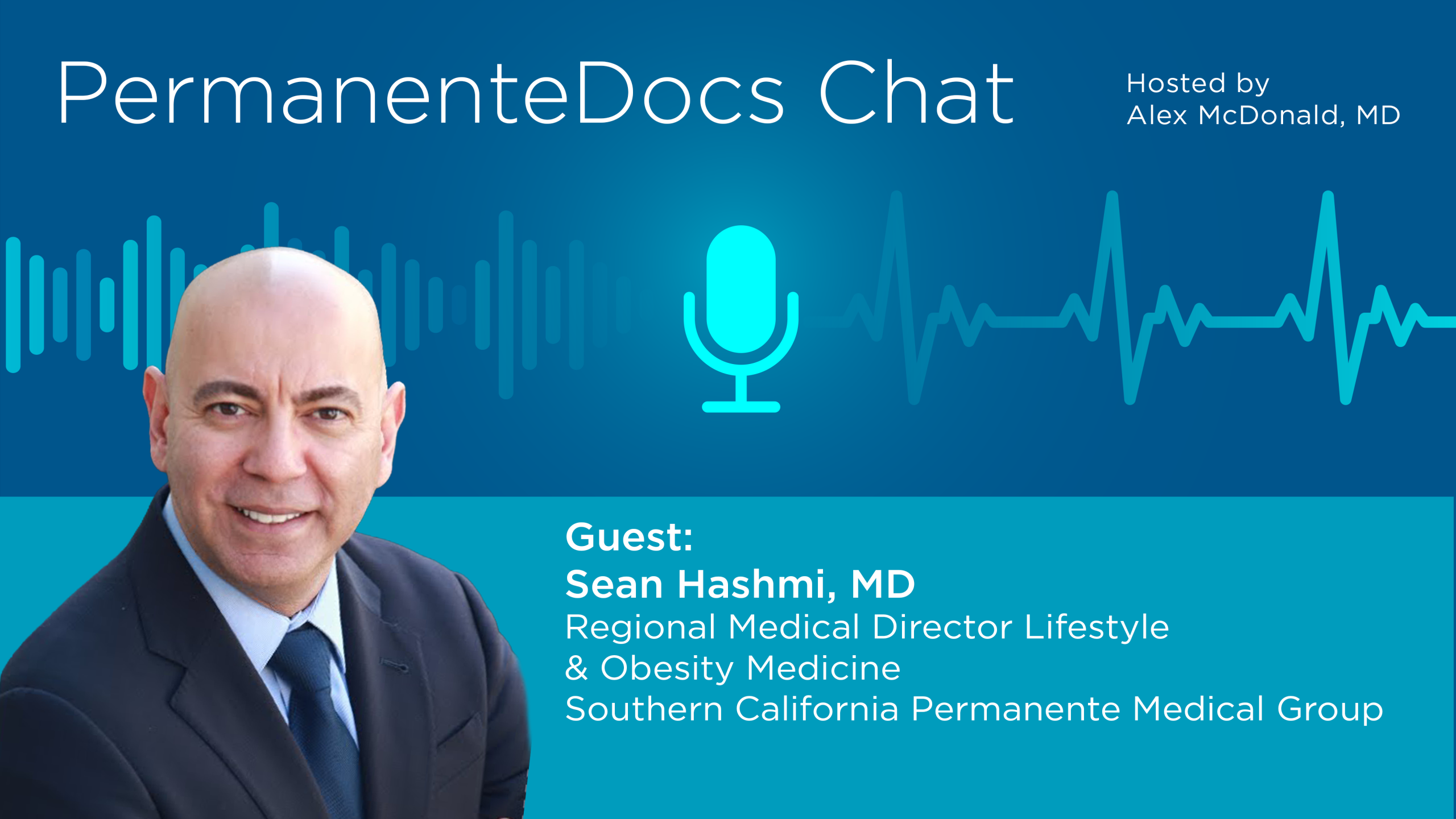
GLP-1 medications are reshaping the conversation around metabolic health and weight loss — but questions remain. In this PermanenteDocs Chat, Alex McDonald, MD, speaks with Sean Hashmi, MD, nephrologist and obesity medicine specialist, about how clinicians should prescribe GLP-1 and other weight loss medications as part of a total weight management approach. The discussion explores clinical evidence, common points of failure, lifestyle medicine integration, and how to set realistic patient expectations. Designed for physicians navigating uncertainty, patient demand, and long-term outcomes.
Guest
Sean Hashmi, MD
Regional Medical Director, Lifestyle and Obesity Medicine
Southern California Permanente Medical Group
National Chair, Interregional Clinical Practice Group – Lifestyle and Obesity Medicine
The Permanente Federation
The Permanente Federation
Podcast transcript
Transcript is autogenerated. Although edited for clarity, it should not be considered an exact replication of the podcast and may also be updated as needed.
Alex McDonald, MD: Welcome everyone to today’s PermanenteDocs Chat. I’m your host, Alex McDonald. I practice family and sports medicine here in Fontana, California. And today we are talking about lifestyle medicine, weight loss, and medication as part of both of those components, and particularly the GLP-1 receptor agonist medications. And we are joined by Dr. Sean Hashmi. So Dr. Hashmi, thank you so much for joining us today.
Sean Hashmi, MD: My pleasure. My pleasure.
AM: So let’s jump in here to talk more specifically about GLP-1s, because I know that’s what our audience is really thirsty to hear about. So from a primary care frontline clinician’s perspective, what do you wish more primary care doctors knew about GLP-1 medications? What’s missing? What do you wish they knew when we’re having these conversations with patients, when we’re learning about these medications and how they fit into our overall treatment plans?
SH: I was asked this question at a conference I just spoke at, and I was listening. I was surrounded by folks that were representing different aspects of health care. Some were from the pharma side, some were other side. And the way that I explained it to the audience there was the same concept. I said, when you look at a carpenter, a carpenter has a tool belt and there’s all these tools. And in those tools, let’s take a hammer, for example.
A hammer can be used to build this house, but just as easily, the hammer can be used to break down the house. The ability for the hammer to do each task is dependent on the user. So when it comes to GLP-1s, GLP-1s are a tool. They’re not the only tool, but they are a tool. The reason that they have gained so much traction so rapidly is because when we talk about why people eat, it actually turns out that the reason that people end up eating is for a few different reasons. The first one is some people eat because when they eat, they never feel the sense of fullness in their stomach. So as a result of it, when they’re finished eating, in 30 minutes, 60 minutes, 90 minutes later, they feel hungry again. They want to eat.
Others are where they crave. There’s a food noise that doesn’t stop and it always exists. And it’s always telling them, “I need sweets. I need something salty. I need something fried.” But that food noise is always there. Then there’s another component of it, and that’s where people end up being what we call emotional eaters. The second that they get stressed, the second that life sort of gives them a curve ball, they turn towards food because food is their friend. And as a result of that, the friend has always been there through good times, bad times. He or she, in this particular case, does not judge them, is always present. And that’s a different type. So when we start to talk about GLP-1s, they don’t solve every problem. They solve a couple of problems. First one they solve is the sense of never feeling full. They slow down food from going through your stomach, so you feel that sensation of fullness.
The second part where they work really well is they’ll go inside the brain and start to tell that food noise to calm down. So that’s another great thing. So as you start to think about it, you say, well, okay, that all makes sense. Then why is it that we should be concerned about issues or once again, the hammer is used properly. The reason for it is when you start to look at the patient’s journey, obesity is a chronic disease. It is not a one-time thing. And so when you have a patient in your office, one, as a primary care frontline doctor, it’s very important to understand, if you don’t set up the patient for success, they will not be successful on bariatric surgery. They will not be successful on GLP-1s or anything else that you decide to do for them. So what does that mean?
First, you have to make sure you understand with GLP-1s, set the right expectations. The faster the weight loss, the faster the weight recidivism or weight regain. So what are we aiming for? We tell patients a healthy weight loss on a calorie-restricted healthy diet is at most we’re aiming for 1 to 2 pounds a week at most. We’re not aiming for 10 pounds or anything crazy like that. And the reason for it is because when you lose weight on these drugs, 30 to 50% of the weight you lose comes from muscle.
The second part of this is the fact that within the first couple of days, you’re looking at almost half the people are going to get some kind of gastrointestinal side effects, nausea, vomiting, diarrhea, constipation. And so you have to set up the patient for success. So what does that mean? Mrs. Jones, when you start to take these things, it’s really important that we start with the lifestyle piece because if you eat foods that are rich in simple sugars, cookies, candies, juices, sodas, alcohol, right? What’s going to end up happening is those with GLP-1s, you’re going to have more GI side effects. If you’re eating fried foods, you’re going to have more GI side effects.
Second part of this that becomes really important is realistic expectations for the patient. Patient comes in and says, look, I saw X, Y, and Z celebrity, certain tennis player or somebody else, certain TV hosts, I won’t mention any names, but I saw somebody and they lost all this weight. I want that. I understand. That’s great. But what we’re going to do for you is we’re going to work with you to design a program that this becomes the very last time we ever talk about quote unquote diets. We’re going to change it into a lifestyle. We’re going to create an entire support system around you. That’s why when you look at all of Kaiser Permanente, every single one of our regions has offerings around health education. We understand the power that lies behind lifestyle, and lifestyle is nothing more than SELF [sleep, exercise, love, and food]. And if we’re able to do that, that sets them up.
And the final piece to this is we are oftentimes starting GLP-1s, but forgetting some of the basics like obstructive sleep apnea (OSA). The majority of our patients are actually dealing with it, and oftentimes is severe. So most people understand that excess weight causes excess fat around the airway, leads to obstructive sleep apnea. What they don’t realize is that OSA causes weight gain. It creates the inflammation, reads the insulin resistance, which then drives any excess calories to get stored, also stimulates your cravings for food. So it’s this vicious cycle. And that’s why GLP-1s are very confusing, but if you want a patient to be successful on them, you want to make sure you’ve got the lifestyle, you got the right expectations, you know what the entry point is, what the duration is, and more importantly, what happens when they hit a weight and quote unquote, what is the endpoint of GLP-1s?
AM: Yeah. You had just hit on so many great points and foreshadowing of multiple questions I have on my list, but I think it’s so important in just setting our patients up for the right expectations. I had a young patient come in who’s struggling with obesity and he said, “Doc, I don’t have time to go to the gym. Can you just prescribe me a medication?” And I said, “Hang on, time out. ” That’s not how this works. It needs to be part of a comprehensive approach. And really setting those expectations and having patients understand that I think is so important. I always will start with diet and exercise. I’ll often have our patients attend nutrition classes before we even talk about medications to build those lifestyle and those support pieces around them, which are going to then make the medications most beneficial.
I’m glad I’m not way off base from what you’re telling me. So let’s say, for example, from a clinical perspective, if a patient in front of us in clinic, how do we determine where we start? Do we start with health education? Do we start with exercise? Do we start with GLP-1? Do we start with another medication for weight loss? How do we decide from a clinical perspective where we start with each patient?
SH: Yeah, this is a great point. So if you look at GLP-1s and you talk about the failure rate of GLP-1s, you’re talking that in 12 to 18 months, 50% to as much as 80% of the people are quote-unquote failing. Whether they’ve stopped losing weight, they have very severe side effects, whatever the reason is, we’re calling it a failure, and there’s patients who are taking these drugs and they’re getting stuck on it. So when you see a patient, we want to do the lifestyle piece first, during, and after. The reason we say we want it first is once again, if you look at setting the patient up for success, if you want them to be able to last on this program long-term, you want them to start to understand how to eat better because if they’re not eating better, you’re setting themselves up for failure.
If you don’t talk about alcohol, the fact that they’re going to go and start drinking while they’re on GLP-1, spending time in the bathroom, having severe nausea, vomiting, diarrhea, or God forbid, if they already have comorbid conditions such as heart failure, et cetera, they’re on diuretics, now they get GI side effects. And what we worry about is acute kidney injury. And that’s something that we see over and over and over again. So once again, if you’re deciding on a GLP-1, is the patient starting to do the right stuff? And if they’re not, what is our opportunity? So health education is the basis of everything. And we have different names for it. In Southern California, there’s one term, but at the end of the day, all of these things are all about the fact that what we’re doing is setting up the patient for success. And for success once again means we address the SELF principle, all four aspects. Now, the exercise component, the reason it’s such a big deal and is forgotten is because when you’re talking about metabolism, every single time somebody loses weight, their metabolic rate drops. There isn’t a single drug on the planet that boosts up your metabolic rate, doesn’t exist.
And so as a result, the only thing we know is if you can create an afterburn effect, what does that? Strength training. If I go walk for an hour, I’ll burn a couple of hundred calories depending on how fast, what’s the incline, blah, blah, blah. But if I do strength training and I’m building lean muscle, that muscle is requiring more energy 24 hours a day, 7 days a week. And if you look at some of the folks when they talk about what is the single greatest variable for how long you live, turns out it’s a marker called VO2 max. Well, what is VO2 max? It’s the ability to be able to take in a whole bunch of oxygen. But what good is oxygen if you cannot use it? And the only thing that’s going to pull the oxygen out of the blood is muscle.
AM: Interesting. You’re talking to a family doc who’s trained in sports medicine also and is constantly preaching to patients the importance of strength training, especially as we accumulate birthdays, I think strength training becomes more and more important. And with GLP-1s, we know there’s a component of, again, as you said, muscle loss and sarcopenia. And to combat some of those muscle losses, I think is really important that we incorporate strength training as part of diet, sleep, exercise, lifestyle, but then also to help improve their, again, metabolic burn, but also minimize some of those side effects from the GLP-1. Because obviously we know, especially some of our older patients, sarcopenia can be a severe problem resulting in balance issues and falls and fractures and you name it, and all kinds of long-term problems.
Okay, so we already talked about some of these medications and setting real expectations. What are the most common side effects? Does it really depend on the person or does it depend on what they’re eating or what they’re not eating? How do you tailor the expected side effects to the individual patient?
SH: So first is, it’s almost like you have to set them up for success, which means if you tell them to expect a certain degree of GI issues, if you tell them they’re not going to feel anything, they’re in for rude awakening. But if you tell them, you can expect this. And the way to be able to do that is a couple of things. First, a couple of days after your first shot, you’re going to feel like the side effects are the greatest. They will taper off. Number two, what you eat matters. Everybody’s going to have birthdays, holidays, Thanksgiving, New Year’s, name your dates. But if you go and have a bunch of high-sugar foods and you’re on a GLP-1, a couple of things happen. First, of course, it’s going to make you spend time in the bathroom. But two, that becomes important is every single time you’re able to eat more, you train this supercomputer that we call your brain, how to overcome the block to cravings that the GLP-1 is creating.
So when patients come back and they say, “Doc, when I started the drug, I used to feel like I had no cravings, and now everything’s back.” And the reason is we are so good at adapting as human beings, as evolution is done, and we are also so good at overcoming things like medications. So that adaptation is real, occurs, and we want to be able to have tricks to go around. And one of those tricks is every single morning when you wake up, you have this little willpower. You have to understand this concept because this is critical to people who’ve been incredibly successful. So what you want to know is if you want to be successful in improving your health, don’t make decisions. Now, I know that sounds crazy. What are you talking about? Don’t make decisions. Don’t make decisions because your little bank of willpower gets exhausted by the first couple of decisions you make in the day.
And what you instead want to do is you want to plan yourself for success. So you should already know I wake up every morning, let’s say I wake up at 6 AM, I go work out. That decision is already made. I don’t have to think twice. I have the shoes next to my bed. I don’t have to think twice. I know what I’m going to do in the gym. In my case, I have a gym in the house. I know exactly the workout I’m going to do. Breakfast, I already know what I’m going to eat. I’m not going to go there and start looking at the refrigerator and say, “This sounds really good today.” Because whenever you start doing those conversations, you have the good side and maybe a little bit not the good side and they’re fighting and your willpower goes down. Now, let’s say you go to work and the boss is like, whoever your boss is, talking about GLP-1s, you’re like, “Oh my God, somebody wants GLP-1. They’re mad about it. Oh, I’m so stressed. Lunchtime. I got to eat something bad because I need that sugar because I deserve it. It’s been a really hard day.” Well, your willpower is already gone.
But if you already knew this is what I do for lunch, the beauty of life is that there are so many places to find pleasure. So if you think food is the only thing that gives you pleasure, let’s reframe that. What’s your circle of trust? What’s your friends? What’s your family like? What are you doing that brings you joy? There’s a very good coach who does wrestling, and I was listening to this speech and he said, the reason that a lot of wrestlers, they struggle with the training, this wrestling training is incredibly hard. They struggle because they only look at the training right now. If you reframe that and you look past the training at the person you’re going to be a month from now, 6 months, 12 months, you start to forget the immediate pain and you start to see the pleasure in whoever you’re about to come.
And that’s the thing that I try to express to patients is you are beautiful, you deserve happiness. Our job is how do we make a team? We create a circle of trust. How do we make it so that you feel that this is a safe space for you? And if I don’t know the answers, I will find the right member to make sure we can find the answer to support you on it.
AM: I love so much about what you just said and what you talked about in creating habits and creating systems. One of my biggest pieces of advice for folks who have trouble, for example, exercising is I tell them to go meet a friend. Go meet a friend for a walk or go meet a friend at the gym. We are social creatures and creating habits that involve with being with other people. My patient walked in the other day, has a t-shirt that says, “Run with friends, it’s cheaper than therapy.” And I think that sort of cathartic benefit, again, thinking about the whole person, not just the physical activity, but the emotional outlet that can be used and utilized when you’re exercising with a friend and you’re talking and you’re socializing. And so I think making it fun, building systems and support people around you so that you don’t have to decide to get up and go meet your friend to go for a walk, it’s already decided ahead of time.
So I love that. Don’t make choices. I think that’s a great piece. I want to chat about, you mentioned a little bit about diet and obviously some new guidelines came out regarding the food and nutrition from the Secretary of Health and Human Services. And I want to delve into that. You talked about there’s a million diets out there and there’s a million different people out there. And how do you help a person decide, again, what’s going to work for them? One of the things that I always tell patients is food and diet is very individualized. There’s no one size fits all. And unfortunately, we have to do a little bit of trial and error to find the right fit for the right person. But I want to know from your perspective and all the research you’ve done around diet and dietary guidelines, what do you tell patients and what do you recommend that doctors tell their patients?
SH: This is an excellent question. When we look at the 2020 to 2025 guidelines, and then we compare that to 2025, moving on to 2030, there’s a couple things that I think a lot of people are missing. It’s very easy to look at something and say, “Oh my God, this little piece of the pie looks different. In this case, there was a pyramid this way, there’s a pyramid this way.” The thing about pyramids though is the idea behind the pyramid was that it would make it easier for people to visually understand. It never had that impact. It really didn’t. So if you go back several years, you’ll see that there was a change across all sorts of national bodies, including within our organization as well, where we looked at what do we do to make it simpler for the patient to understand? Patients are not supposed to be doctors or dieticians or trainers or so forth.
So when a patient is looking at their plate, a plate does not look like a pyramid. And so what can we do to make it easier? And so we talked about this concept of a healthy plate. And what’s a healthy plate? Well, half your plate is things like fruits and vegetables. A quarter of your plate is things like whole grains, brown rice, et cetera. And then the quarter of your plate is protein. Protein can come from a variety of sources. It can come from things like tofu, it can come from beans, it can come from lentils, it can come from chicken, it can come from fish, it can come from eggs, it can even come from things like red meat. What you’ll find both in the new guidelines and the old guidelines is that there’s still an emphasis on whole foods, minimally processed, fruits and vegetables are still on there, and those items are very, very important to the foundation of the healthy plate.
SH: So instead of us getting into the weeds and getting stuck there, I can tell you as a patient, not as a doctor, but I’m a patient too. As a patient, when I look at my plate, I get lost. And so when I talk to my patients, they love the idea of a healthy plate. They love the idea that all I really need to think about is if food is coming in packages, is it really healthy for me? And there’s nothing in the new guidelines and nothing in the old guidelines that contradicts that. Even things like when we talk about fruits and vegetables, fruits and vegetables are an amazing source of antioxidants. They’re an amazing source of vitamins, minerals, fiber. All of those things are there. So with the new guidelines, fiber still continues to be an important part of it. It’s written in the statement of fruits and vegetables.
Other things like alcohol. When we look at the data around alcohol, we know that yes, a lot of people enjoy it, but there’s really no real safe drinking limit. And if you’re going to have it, we have some guidelines around it that are still endorsed by a number of national bodies. So less is always going to be more when it comes to things like alcohol. And there are things that if you’re the numbers type of guy and you want a specific number, we can give you those numbers. If you’re somebody who gets overwhelmed, then it says less is more. There’s really no safe limit in terms of drinking. If you can stay away from it, great. If you have to drink it, here’s the amount that gives you the least risk possible. So when you look at the new versus the old guidelines, instead of us always focusing on what’s different, how about we start to focus on what can we tell the patient to create less confusion?
How can we guide them from thousands and thousands of studies that are done from different populations in different groups that starts to say the same concept, which is once again, whole, minimally processed foods are still healthy things and things that are round and have another circle in between aren’t going to be on any dietary guidelines as recommended foods.
AM: I always like telling my patients that anything that comes in a box, a bag, or a package probably has more salt, sugar, and chemicals than anything else. So the important thing to remember about food labels is to avoid foods that have labels and boxes and packages. And that’s I always like telling my patients, but I love that. I love that emphasis on a whole food plant-based diet. That’s really important.
I want to touch base really quickly on something you said earlier regarding food as pleasure and the joy of eating. You alluded to this earlier. Most cultures, food is a place of enjoyment and family and connection. And a lot of our core memories growing up involve holidays and foods and things. How do we help our patients figure out other ways to deal with their stress or to express joy or pleasure or celebration other than food?
Because I think especially in our culture, something great happens, you go to dinner or you have some birthday cake, and that’s fine in moderation, but I feel like a lot of my patients I’ve experienced have an unhealthy relationship with food and how do we help them start to unpackage that because it can be really complicated.
SH: It can be complicated. The first part of thinking about that seeking pleasure or avoiding pain is when people talk about how eating that food gave them pleasure, let’s take a step back. If you sat there and ate food, let’s say I wanted a chocolate cake and I really think I deserve it. I ate it. That’s two seconds of pleasure that I had from it and then it’s gone. But when we do it within the company of people, you forget that it’s not that the chocolate cake tasted better in the company of those people, it’s that the company of those people made you feel good, and that’s why the food tasted better. So in other words, you can take the food part out of it and realize the company’s very important. Number two is the people that you bring into your circle. Those have to be people that you talk about your goals, your desires, your dreams.
Dr. McDonald, let’s say you’re my brother. We’re sitting down together. Alex, you and I, I wanted to share with you, I’m really trying to be healthy. I got kids now, I’m getting older, and I really want you to know I’m going to be working on this diet and when we go out, if you can just support me on this because I’m going to need that help. Now I have my own family member right there saying, “You know what? I get it. I love the fact that you’re trying and you’re now motivating me. I want to try too.” So instead of feeling like you’re the oddball out that you’re not the joy of the party because you’re not having that, what you’re doing is sharing your dreams, sharing your hopes, sharing the person you’re trying to become with them because the people who love you, they will start to realize that.
Now, it might not work the first time. They might be like all sorts of things, but you know what? Realize that the people you have in your circle are the ones that make your success. I never saw an athlete become successful by themselves. There were coaches, there were family members, the parents who took time out of their work to drive them. It takes a village to create success. So why don’t we build the ideal village instead of feeling ashamed that we’re eating healthy or feeling like we’re not part of the cool crowd? Instead, we are the example. If you want to change the world, start with yourself and then share that experience and say, “Look, I love you and I want you to be around and I’m changing myself and I want you to join me. ” That’s it.
AM: I love that. This has been such a great conversation. I do have two key questions I want to get to before we wrap up here, although this is wonderful. Regarding GLP-1 specifically, so obviously physicians are extremely busy. How do we balance having these conversations, having these interactions with patients, responsible prescribing of medications as part of a weight loss journey and a lifestyle journey? So my two questions specifically is, how do you talk about duration of therapy when we’re talking about GLP-1s? Is this something patients are going to be on forever? Are they going to be on it for a year, for 2 years? How do we measure success and duration of therapy? And then probably most importantly, if we stop a medication, how do we deal with weight regain? Because I know that can be an issue for some folks.
And some of my patients who have been on GLP-1s for a number of years and done very, very well, they are terrified of stopping their medication because they are terrified of regaining the weight. And how do you address that as a frontline physician? I know that’s a lot loaded into that one question, but please help us out.
SH: So first part of this is because we’re so busy and we might have 10 minutes, 20 minutes, whatever the time it is that you have in your clinic, you can’t possibly address everything. No.
That’s why you have to realize that as an organization, you have all these tools available to you. You want to encourage the use of health education. If you look at kp.org, there’s so many health and wellness and fitness resources that are free of use available to our members. We want to encourage that. What we’re trying to go after is the idea that a physician visit is one visit and then there’s a break, sometimes three months, sometimes six months. In between, we can have an RN do a check to see how things are coming, make sure everything’s okay. We can have a pharmacist do a check to see how things are going. We can even have our back office staff to do a check. So the concept here is we’re trying to create touchpoints. The second part of this is we are trying to take Kaiser Permanente and come into their home through digital tools, kp.org, on your phone.
We can do the visit without you having to come in. Those things set you up for success. Now, the second part is, well, what about duration? So obesity is a disease and it is a chronic disease. And that is really key to understand. That means that unfortunately it’s going to be with you for the rest of your life. That does not mean a GLP-1 has to be the chronic only treatment. There are other medications that have been around for a while. We can use those. We talked about this concept of habits. Habits take anywhere between 2 weeks or 14 days up to 255 days. That’s why people quote the 66-day number. 66 days is incorrect. It is a false statement. Each person is different between 14 days and 255 days. So knowing that, the more we can take the decisions away from you, the more we can build consistent, steady patterns, the more likely you are to be successful.
That means that you have to know Christmas is going to come every single year. Your birthday is going to come every single year. What are you doing for that social moat? What are you doing to create that circle of trust around you? And the most successful people I know who have gone off GLP-1s, who have lost an enormous amount of weight and kept it off without it. They still have a routine. They still work out regularly. They still eat whole foods, minimally processed, predominantly plants. The reason they do all of these things, they focus on their sleep is because they know that the secret to their success wasn’t one drug. It was systems and all they needed was a little help to go through the door and the door to success. Now that they’re in it, they figured out that once again, the tool, the hammer in your tool belt, can build you or can break you.
We still don’t know if there’s going to be any long-term issues. We’re targeting the pleasure centers of the brain. There were some concerns over suicide risk that came up early in the GLP-1 starting era. Those things now, the data shows that that’s not necessarily the case, but we still caution because there’s a risk of increased depression in vulnerable patients and there can be suicidal ideation. So we don’t want to wait. We want to know that blocking your pleasure centers does affect other aspects in vulnerable populations. So the point here is it’s not that GLP-1s are for eternity. It’s that if you think of obesity as a chronic disease and you have all these tools, including GLP-1s, our job is to figure out the best tools with the least side effects, the most safety. So in other words, still making sure there’s quality, still making sure that we are putting the patient in the middle and doing this for the long run.
AM: Yeah. And I think honestly, I’m super proud of Kaiser Permanente for our patient-centered approach. Just like you talked about, we can have touchpoints with nurses and nutritionists and pharmacists and physicians and LVNs. It’s really a team-based approach that can wrap around the patient and help that patient build their system and build their team however it fits them individually as a patient as opposed to a one-size-fits-all, which we know does not work. Dr. Hashmi, thank you so much for joining us. This is a phenomenal conversation. I feel like we need another hour to go into more of these details, but for the sake of brevity and our listeners out there, I have one last question. This is my favorite question. What makes you most proud to be a Permanente physician?
SH: I think the biggest thing is my daughters were born here. The greatest testament you’ll ever have of an organization is it’s like the hair club for men. I’m probably not the best person to answer this, but not only am I the spokesperson, but I’m also one of the members. That’s exactly it. All of our physicians are members. Most of us, we’ve seen my parents get care within [Kaiser] Permanente. My daughters were born here. They go get their treatment. They see the sports med guys a lot because they do wrestling and they get injured a lot. So if we don’t believe in it, we wouldn’t be part of it. And that’s what makes this organization so unique and so beautiful is not only are we the spokespeople for it, we’re also the hair club for men users for it.
AM: My wife told me I had a receding hairline the other day. I got very offended, but it is what it is. Well, thank you so much for joining us. We really appreciate your time and energy and passion around this topic.
SH: You got it. Thanks for having me.
AM: Yeah. And most importantly, thanks for all of you out there listening. We really appreciate your ideas and content. So make sure you reach out to us, subscribe to the YouTube channel, smash that like button or whatever the kids are saying these days. And if anything else comes up in questions, reach out to us. We want to know what you want to hear about on this podcast. So thanks all.
Related Posts