Learn how effective health education can enhance physician-patient partnerships and promote healthier habits for better outcomes.
The future of care at home





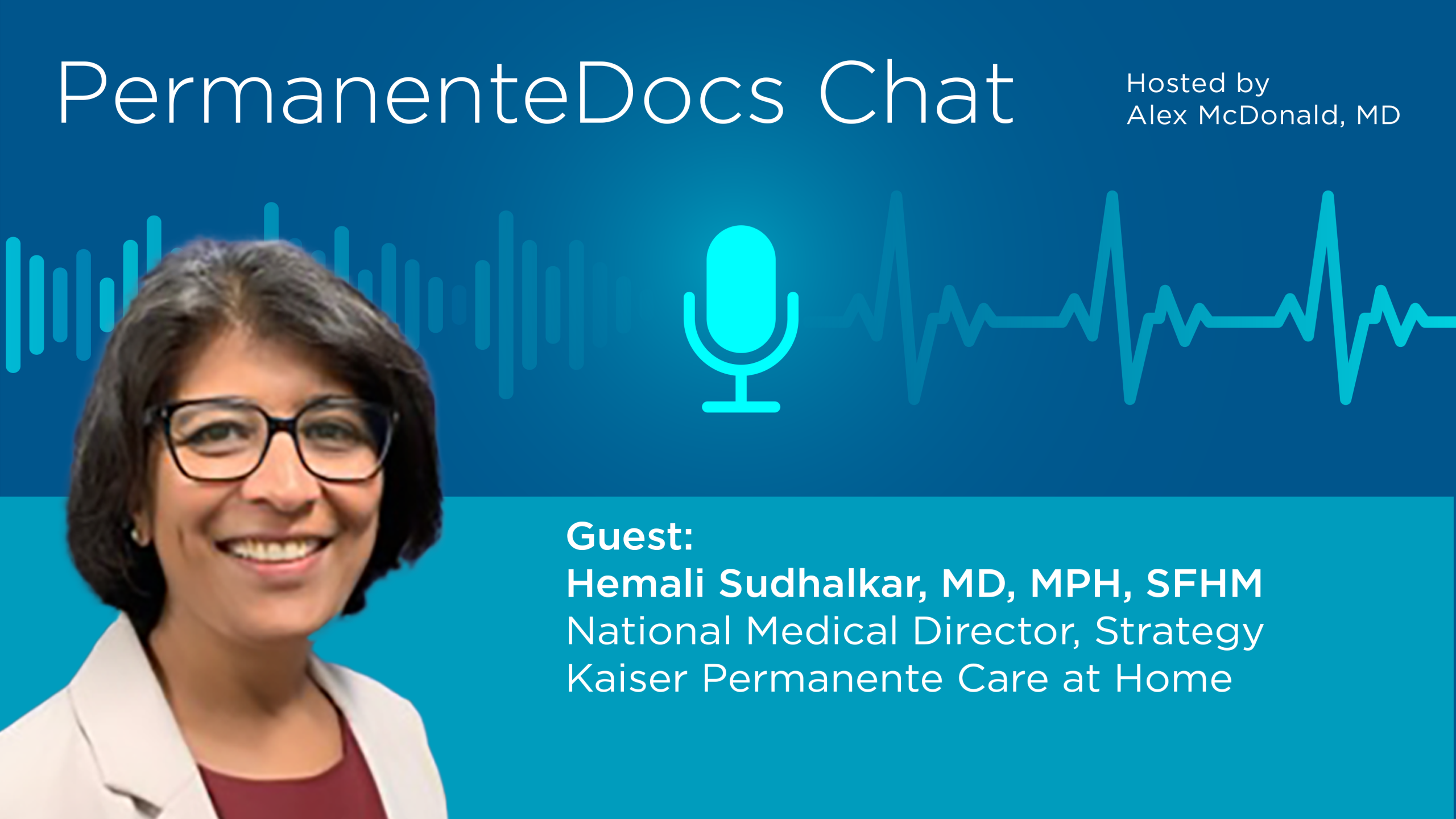
In this PermanenteDocs Chat, host Alex McDonald, MD, speaks with Hemali Sudhalkar, MD, MPH, SFHM, hospitalist, inpatient palliative care physician, and National Medical Director of Strategy for Kaiser Permanente Care at Home, about how Advanced Care at Home delivers hospital-level care in patients’ homes.
Dr. Sudhalkar explains why this shift is essential as the U.S. population ages and capacity strains grow, and how Kaiser Permanente’s integrated model enables safe, coordinated care beyond the hospital. She shares early results from Northern California, where nearly 4,000 patients have received care since 2020, with average length of stay reduced from 5.5 to 3.5 days, hospital readmissions 3% lower, and likelihood-to-recommend scores 10 points higher than inpatient care.
The conversation covers clinician training, virtual nursing, and home visits — plus the policy steps needed to expand and sustain this model nationwide.
Guest
Hemali Sudhalkar, MD, MPH, SFHM
Hospitalist, inpatient palliative care physician, and National Medical Director of Strategy for Kaiser Permanente Care at Home
Podcast transcript
Alex McDonald, MD: Welcome everyone to today’s PermanenteDocs Chat. I’m your host, Alex McDonald as always, and today I’m joined by Dr. Hemali Sudhalkar and we are talking about what I like to refer to as the ultimate in patient-centered care: advanced care at home and Kaiser Permanente’s innovative approach. So Dr. Sudhalkar, welcome so much. Thank you for being on the program.
Hemali Sudhalkar, MD, MPH, SFHM: Oh, I’m glad to be here and thank you for taking the time.
AM: Wonderful. Well, let’s start by my first tried and true question. Tell the audience who you are and what you do.
HS: Yes, I’m Hemali Sudhalkar. I am a hospitalist and an inpatient palliative care physician at one of the 21 hospitals in Northern California, Kaiser Permanente. I work in the San Jose Medical Center. Actually, including my training, I’ve been with Kaiser Permanente for over 24 years and this is the best that has been for my career. Over the years I’ve had leadership roles and for the past 6 1/2 years I’ve been the regional medical director for what we call TPMG, The Permanente Medical Group. Currently my portfolio is hospital strategic initiatives; basically those are the programs that don’t fit into the 4 walls of the hospital, but it’s connected, so it’s like continuity of care before and after hospitalization. And I also have a national role, I’m the national medical director of strategy for Kaiser Permanente Care at Home.
AM: Wonderful, thanks so much. So you have a lot of both clinical and administrative and operational experience to speak to this and I’ve read some of your prior work and some of your articles and things you’ve put out before. And you’ve really talked about imagining a future where hospitals are primarily just for emergencies and surgeries and critical care and everything else can be managed outside the 4 walls of the hospital. Can you talk about the trends and the factors across the health care landscape that you see driving us in that direction?
HS: Yeah, sure. But before that, I also want to say that I was reading your bio and I love that you believe in lifestyle medicine and exercise, and one of the things I read about was holistic approach to care. And I believe in that specifically for all the programs that we’ll be talking about today, specifically at care at home, it’s geared towards what our patients and our members are telling us what they would like and what matters most to them. So felt like I had to mention that before we continue our conversation.
AM: And as I said, this is the ultimate in patient-centered care. It’s the care comes to the patient as opposed to making the patient come to us, but we could go on about that all day.
The vision of truly patient-centered care at home
HS: Exactly. So I think, this is again a prediction, from what you have seen how medicine has evolved. I know that I’m aging myself here, but when I started as an attending physician — what that means for people outside of medicine is that you finish your training and you become your own independent doctor — when patients used to come into the hospital to get total joint replacement, that is either knee or hip replacement, they would stay in the hospital for 4 to 5 days.
You may ask me what happens now. More than 80% of the patients, as you know, in all of Kaiser Permanente markets, which we have 8 of them, they go home the same day. We call it the home recovery program. So they come into the post-acute care recovery and from there they go home. That is an example of care at home. My prediction is that in the next several years or maybe a decade or two, what will hospitals look like is just emergency departments, operating rooms, some complex, we call it MCH — which is the delivery and ICUs for adults and kids — and complex procedures. The rest of the care could be at alternate settings.
AM: I think that’s such a great vision. I practice both hospital medicine as well as outpatient family medicine, and I have a lot of times patients who are just getting IV antibiotics for a couple days and they’re like, can I go home? And a lot of times they can’t without that infrastructure and that ability to do that care. Also, I think the same thing when I was in medical school, maternity care after deliveries, patients were in the hospital for much longer periods of time where we realized when we can get them physical therapy at home, we can get them social work and nursing visits and wound care at home. That’s just a win for everybody. We know patients recover and do better at home or there’s gaps in care between the hospital and primary care and home care. And so I think it’s great. I love this vision. I love this idea both as a physician and as just someone who’s really interested in health policy overall. So with that in mind, how are health care organizations responding to create these home care programs or make sure there isn’t a gap in continuity between surgery and recovery? Can you describe example of how this operates outside of the Kaiser Permanente system and then also what’s unique about the care at home within Kaiser Permanente?
AM: Yeah, I just want to take a step back and tell you why is it an imperative for us to think about this. The largest growing demographic in our country is older adults, 65 and above. In 2020 it was 56 million people, and about in 2050 it is going to be 82 million.
Now, we learned during COVID-19 that we are not able to take care of all our patients in the hospital setting. So it is an imperative for us to increase the capacity and the capabilities of taking care of our patients with high-quality and safe care. Care at home is relatively a new concept coming out of COVID. I was just at the hospital at home World Congress in Vienna this year, in March. A lot of European countries and other countries, France, UK, Germany, Singapore, Australia, Israel have been doing this for decades. So there is a lot for us to learn from them. And what we are realizing is, as you said, there are unintended consequences of patients being in the hospital with deconditioning, hospital-acquired infections. We can actually prevent them. And we also learn from patients that they would like to be home as much as possible. So there are a lot of programs out there in the country with big organizations as well as small organizations. It’s a national movement in our country. So you have Mass General, Brigham, Mayo Clinic, Cleveland Clinic, Kaiser Permanente, we are all looking at how can we innovate to make sure that we are taking care of our patients at home when possible.
Taking care of patients at home: what it looks like outside of and within Kaiser Permanente
AM: Yeah, that makes perfect sense. Well, help me understand more about how that looks outside of Kaiser Permanente and then also how it’s different within Kaiser Permanente because I do think there’s some nuances there.
HS: What I want to say is that a lot of the organizations outside of Kaiser Permanente that I know of, they’re in different stages. First of all, this is really important that organizations are able to invest, and this is where we need, from what you mentioned earlier, the advocacy to make sure that this is part of the care that we provide and it is embedded into the government agencies that help us create these models. Because when you start this, it’s almost like a startup. So there is an upfront investment and it’s really hard for a lot of smaller organizations to do this without knowing that they have future in this. So right now a lot of advocacy is going on with the Centers for Medicare and Medicaid Services (CMS) and others to make sure that we continue this. And good news is that there is bipartisan support for this work because everybody understands that this is really important for our patients. So there are programs out there which has hospital at home, urgent care at home, observation status at home, and looking at a lot of other programs like remote patient monitoring, emergency care at home. There are some programs that also do chemotherapy at home. So there is a lot of programs out there.
AM: I think with the advent of technology and especially the COVID pandemic, I feel like it’s sort of forced our hand a little bit here. We started doing more of this work out of necessity and then we realized, wait, we can do this. We can do this safely, especially with remote monitoring and home visits. I also appreciate the irony of the fact that 200 years ago, doctors used to make house calls and then we are like, wait, it’s more efficient maybe if we put all the patients in one building and have the doctors work in the building. And now here we are shifting back towards that truly patient-centered home care. So I have to point out the irony of this situation, but what’s old is new again, or something along those lines, right?
HS: We recently had a patient who used to live in France and he actually got the opportunity to be part of the Advanced Care at Home program, and he was saying that, oh, this is what I’d experienced in my country, and now you have two, which is great. So it was good to have that validation, but I can also mention what’s happening within Kaiser Permanente. We have 8 regions, Northern California, Southern California, Hawaii, Oregon, state of Washington, Colorado, Georgia, and Mid-Atlantic States, which includes parts of Washington, D.C., Virginia, and Maryland. And at Kaiser Permanente, we call our program Advanced Care at Home where patients get high quality, safe care in the comfort of their own home. And this is with the guiding principle of the care being as safe or safer than brick and mortar.
The Advanced Care at Home program is live in 7 out of 8 regions, with Hawaii going live either at the end of the year or next year. And as you know at Kaiser Permanente we serve over 12 million members. Giving you an example, we started Northern California and Northwest, which is Oregon, 5 years ago, early 2020 during the pandemic. And in Northern California alone, we have taken care of almost 4,000 patients. Currently we have average daily census, which is how many patients do we have in the program on a daily basis, into the mid thirties with touchpoint of about 50 patients. And we are also almost mimicking some of the efficiencies we have elsewhere. So we started out with the length of stay of about 5.2 days, but we have improved significantly where our patients stay about 3 1/2 days in the program. And because of the beauty of our integrated system, they get readily back to their primary care physicians if they need any other home health services or anything else. And what we have seen is that the readmission rate to the hospital is 3% lower than the hospital, and the likelihood to recommend score for care experience is about 10 points higher.
AM: I was going to point to that exact piece, if we can improve the quality, if we can improve the resource utilization and we can improve patient satisfaction, it’s really the quadruple aim. It’s a win-win for everybody. I’ve been able to discharge some patients from the hospital, get them home sooner, more safely, more efficiently. With that help, it’s like an off-ramp to the highway, kind of a transition period. Instead of going from the highway straight to slamming on the brakes at the traffic light, it’s an off ramp where you can smooth that transition. So it’s really much more efficient and effective. And I’ve had patients love it. Some of my colleagues do this work and they love it. It’s really quite beneficial from multiple angles. But again, I always think about the patient-centric piece. You talked about this a little bit earlier about the scalability of some of these models also, and initially this requires a lot of investment upfront. Can you talk about what has made this successful for Kaiser Permanente specifically as you scaled this model up?
HS: Yeah, I think the most important is that it has to fit into the organizational priorities, which for Kaiser Permanente is specifically because it is what our patients want and this is good for the patient care. And one of my colleagues mentioned this is the most innovative care transformation that she has seen in her career. A lot of physicians feel that way. So that is why it’s part of it and making sure that executive sponsors from top to the medical centers, everybody’s in alignment. And I think having that has really helped us move this forward.
Because again, we didn’t start out by as many patients when we started. We would have one or two patients on a daily basis. This is also care transformation for physicians. We are used to doing things in a certain way. As you said, I’m a hospitalist myself and I’m used to doing certain things. And also as doctors, we are very protective of our patients. And even though it’s the same physicians, the hospitalist physicians from my group taking care of patients in the home setting, I need to know. That’s why it’s important for us to talk about patient testimonials, the stories, the outcomes. How do I know that even though I know you Alex, that you’re going to do well in the setting that’s different from what you’re practiced in?
How care at home is evolving the physician’s role
AM: That’s a great point about how does a physician role evolve and change. When I’m routing in the hospital, the workflow in my brain is, okay, does this patient need to stay in the hospital or can they potentially go home from a medical point of view? What are the barriers to getting them home, be it social or medical, and what pieces need to be in place before that? Here I need to almost shift my thinking a little bit and being like what medical care has to be done in the hospital and what medical care potentially could be done at home, and it’s taken me a while. Again, practicing here in San Bernardino County in Southern California, we’re one of the first and one of the largest areas in Southern California to do this work. We’ve been doing it for a couple of years and it’s taken a while. Can you talk more about how the physician role is going to change or evolve when we’re taking care of these patients in settings other than the hospital?
HS: It’s a great question. First of all, I just want to say that as you’re transitioning patients from the 4 walls into the home, you are thinking of what is that level, advanced level of care that I can provide. So we are able to provide video visits with the physician in the home setting twice a day, nursing visits, or more if needed. We also have 24/7 virtual nursing in certain parts of the program that’s available. So just for your awareness, hospital medicine has reached about 25 years and a little more since its birth. It’s relatively a new field where you’re taking care of hospitalized patients and you don’t have a clinic where you’re seeing your patients. And coming out of pandemic with a lot of burnout, with the work we had done, this also provides a little bit of a different area where you can practice.
It’s bringing other kind of rewarding work for you to do. Having said that, it’s also a different way of practicing. So when I’m practicing as a hospitalist in my facility, if I’m having either a bad day or if I have a question, I just run down the hall and talk to my colleague, just go to my office and sit down and talk to someone. It’s not that because you are in a virtual setting, so it is different. We are actually creating that kind of training for our physicians. We are also trying to create a community of practice of physicians who are practicing this. IV antibiotics have you order in the inpatient electronic medical record; it’s different when you do it on a virtual setting because the workflows are different. So we are creating training programs. We are also doing virtual meetings for the physicians to update them. And again, having said that, this is all still in evolution. So we are learning. One of the things that we are really excited about is we participate in national meetings. So for example, next week, a lot of us are going to go to the American Academy of Home Care Medicine where a lot of these things are discussed and one of our physician leaders is going to talk about how we train physicians for this work.
AM: That’s a great point. It’s really interesting and it really takes so many different pieces, people working collaboratively together, and those workflows and developing new patterns. To that point about the diversity of practice, I’m a family physician. I work inpatient, outpatient, I do some sports medicine, I do a bunch of procedures. Variety is the spice of life for me and my own wellness. And I think that’s really key, especially for some of my hospital colleagues who just do hospital medicine who are very burnt out, being able to do some virtual care and home care helps them diversify their practice and helps keep them happier and more well as physicians,
HS: And remember when you’re doing virtual visits, you have the home care nurse going at the time, you have virtual nursing, so you have to collaborate with everyone. It’s not just that you are rounding on patients on your own. So it’s really key. We also try to do in-person monthly get togethers for whoever can come in. So you are kind of connecting. For me, it’s very important that I connect with people in person or in a group, see them, which I’ve missed some of it. So yeah, a lot of variety of work going on to improve.
Behind the metrics: Patient satisfaction, fall rates, infection rates
AM: The personal connection is perfect. So you touched already on some of the benefits here. We’ve learned a lot from these experiences, lower readmission rates, higher patient satisfaction. What are some of the most surprising outcomes that you’ve seen from the medical care at home program?
HS: Let me start out by also letting you know what other quality metrics we are measuring. Definitely we’re doing the regular quality metrics that we do in the hospital setting. Looking at infection rates like you have a IV line, is there an infection there? Are you looking at hospital-acquired pneumonia, is that happening in the home setting or not? So some of those conditions that we measure, we compare it to the hospital. One of the things we learned is that not everything is that right. For example, falls. As a family medicine physician, you may know that rate of falls in the home settings are higher than the hospital.
A lot of elderly people at home fall because of lot of reasons. Actually, there was an review on NPR just last year about it. What we realized is that for falls, we were excluding a lot of the patients that could come home and the patients who could actually receive care at home. So we had to change how we measure the risk of falls, and we had to educate patients and families. And the good news is we have nursing going into the home setting to evaluate. We may even have advanced practice providers going there. What we realized is that we have to compare falls for the home health fall rates.
We now actually serve more patients with high risk of falls, but much less falls because of the education we have done. So that was an interesting finding. And what that taught us is that along our journey of taking care of patients in the home, we have to be vigilant and we have to be ready to evolve and pivot. So we are going to be presenting our data on falls next week at the conference that we have done really well. And that’s pretty rewarding that you are bringing patients home and you’re reducing the risk of other conditions that can happen in the hospital setting.
AM: One of my least favorite things is when I come on service and I realize this patient’s been here for 5 days and they have not gotten out of bed and they just get more deconditioned and weaker and then we’re just make a bad problem worse. Getting patients moving and getting them moving safely and at home, I feel like that’s a win-win for everybody.
HS: That is my pet peeve. I walk my own patients in the hospital and one of the things we call it is mobility medicine. It’s really important for them to get up and move and improve their conditioning. But going back to your question, I want to say that one of the most interesting things that we have discovered is how much the patients love this program. And we can’t underscore that or underestimate. What I say is that if I’m ever in the emergency room and I am qualified, I would always want to go home.
AM: I’ve actually had a patient who requested to do the advanced care at home program, done it before or their family member had done it before, and they were so happy with it. It’s really the ultimate in patient-centered care, which again, is a win for everybody. This has been a great conversation. My last question here, because we try to keep these pretty brief and high yield for our listeners. I want you to look into your crystal ball and look out five years from now, what do you think the role of care at home in the United States and the U.S. health care system is going to look like, and what are the policy or the advocacy steps which are going to make it possible to get there?
HS: First of all, I want to say that CMS published this year the 5-year outcome study of the hospital-at-home waiver that was given during the pandemic. And the most important thing would be for it to be extended for another 5 years or more, or made permanent because the results have shown that we provide better care or as good care as brick and mortar. And as we talked about, the quality outcomes that are much better. So I think it’s really important for the government agencies to implement this so that all the organizations can provide benefit for this to our patients in the country. I think that’s the key. Absolutely it’s important for us to scale it. If we don’t scale, I’ve heard this from a lot of leaders in this space, if we don’t scale, we’ll fail.
Defining care at home
AM: Medical care at home can mean a lot of things to a lot of different people. Can you tell us what your definition of this program is?
HS: For sure, and I’m speaking for myself here, when I think about care at home, what I think of any medical care that we can provide to our members or patients that is outside of the 4 walls of the hospital and institution. And what that mean by is nursing facility. So pretty much how can we take the care to the members where they call it home?
And that is very key to all the work we do. Can that be our North Star as we are providing care to our patients because that’s what they tell us. Most of them would like to be in the home setting to get the care. And I can give you my own example. My mother-in-law, she was 85, was in the emergency room, and she was there with diverticulitis, which is an infection in your large intestine. And she refused to be admitted to the hospital. And I’m talking about 8 years ago. She had the advantage of me as a physician being home. We brought her home, she went back to the clinic the next day to get some hydration, and she recovered so well in the next 3 or 4 days at home. And that is what I talk about care at home, including what we talked about for surgical patients that come home the same day.
AM: And we know patients often will do better at home in their own environment, in their own bed. This is something we’ve known for years.
HS: Their own pets and their own pillows and whatever, they love music. They also enjoy just the comfort. And as providers, when we get chance to go into their home, we can look at what are they eating? This is where it goes to lifestyle medicine, what medications are they taking? Are they taking what they’re not supposed to and how can we improve that?
AM: And as I said before, this is the ultimate in patient-centered care. We really bring the skills and the advanced care to them as opposed to make them come to us in the hospital.
My last question is, what makes you most proud to be a Permanente physician?
HS: I don’t even know where to begin. I just love being a Permanente physician because I don’t have to worry about somebody dictating the care I give my patients. Having said that, I also get to learn the latest evidence-based medicine and what I need to be providing to my patients. At the same time, I get time to listen to my patients. I get time to provide them the best care they need. And most of all, I also get to be a leader in various spaces that I would want to continue the work. So Alex, you are a Permanente physician, so you know this, but we are the leaders. We as physicians, we are the leader shaping health care for all our members. And I’m most proud of that.
AM: Wonderful. I really appreciate that sentiment. I could not agree more. Well, thank you so much for taking time. I think it’s just really wonderful to understand how patients and physicians alike can really gain from this transformation in care delivery and doctors’ responsibilities may shift a little bit from the hospital to more acute and emergency needs in the hospital space, and then also the infrastructure in the policy. We need to really make this sustainable and spread. So Dr. Sudhalkar, thank you so much for your time and your energy and we appreciate you very much.
HS: Thank you very much. And what I would say is to the listeners here, that if you’re listening to this and you are a Kaiser Permanente member, and if you’re ever in the emergency department or hospital, ask your physicians for advanced care at home program.
Related Posts