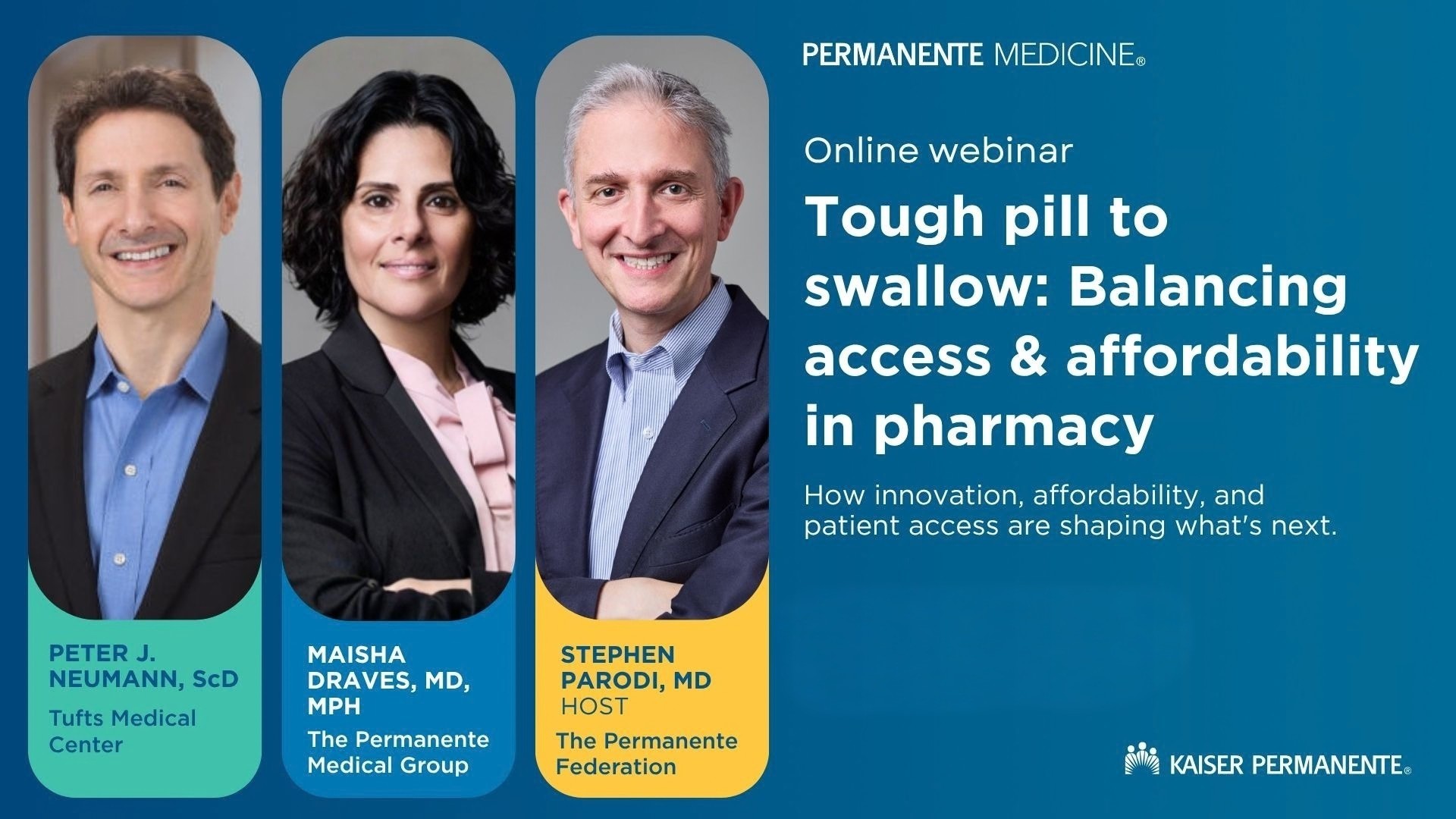
Watch: Learn more about the implications of rising drug prices on affordability and access in the health care system.
WATCH: What’s next for value-based care


This webinar explores what’s next for value-based care and the differences that set it apart from fee-for-service models and the importance of rewarding value over volume. The guests highlight the need for aligning incentives to foster trust between physicians and patients, and the important role of data sharing to achieve better health outcomes in a coordinated system. The conversation also addresses the current policy environment, the growing impact of Medicare Advantage, and the challenges and uncertainty around Medicaid. Finally, the panelists discuss what the future of value-based care would mean for millennials and Gen Z, with a focus on personalization, health care innovations, and maintaining patient trust.
Hosted by Steven Parodi, MD, executive vice president at The Permanente Federation and The Permanente Medical Group, with insights from national leaders in health care:
- Ceci Connolly, president and CEO of the Alliance of Community Health Plans
- Nolan Chang, MD, executive vice president of Strategy, Corporate Development, and Finance for The Permanente Federation
Podcast transcript
Transcript is autogenerated. Although edited for clarity, it should not be considered an exact replication of the podcast and may also be updated as needed.
Stephen Parodi, MD: Welcome to our Permanente Live webinar, “Finding Success in Value-Based Care.” I’m Stephen Parodi, executive vice president at The Permanente Federation and The Permanente Medical Group. Thank you for joining us today for a conversation on defining value-based care, and it’s important in a world with shrinking resources and increasing pressures on health care systems. We’ve all heard about the potential for value-based care. It’s been touted as a solution for what ails American health care, but does it really deliver on that promise? We’re joined today by experts from the physician and payer perspective. To help answer that question, we’ll explore value-based care best practices, examine the different kinds of payment models, and assess how the current policy environment helps or hinders its spread. The common refrain for value-based care is that it rewards value over volume. Today we’ll learn about what value truly means and understand whether it offers a path to better outcomes for our patients and the teams that are providing the care that they need. Let’s meet our guests. With me is Ceci Connolly. She’s the president and CEO of the Alliance of Community Health Plans, a group representing nonprofit health organizations that work to improve affordability and outcomes in health care. ACHP members, including Kaiser Permanente, bring together health plans with physicians and clinicians to deliver better value for our patients and employers. Ceci has long been recognized as one of Modern Healthcare’s 100 Most Influential People, and spent 25 years covering politics and health care as a reporter. Thank you for joining us today, Ceci.
Ceci Connolly: Thank you, Steve. It’s always great to be with one of my terrific board members.
SP: Thank you. And then I’m also joined by my colleague Dr. Nolan Chang, and he is a board-certified family medicine physician and executive vice president of Strategy, Corporate Development and Finance for The Permanente Federation. Over the course of his tenure, he has successfully led health care transformation projects related to telehealth, information technology, facilities, and practice management. He has been named a Great Leader in Health Care in the 2025 by Becker’s Hospital Review. Thank you, Nolan, for joining us today.
Nolan Chang, MD: Thank you, Steve. It’s an honor to be here. I’m really looking forward to the conversation.
Value-based care versus fee for service
SP: Ceci, what is the difference between value-based care and fee for service? Are all value-based care systems the same?
CC: Oh, goodness, no. To the last question that you posed, and I’ll come back to that. But to begin with, and it’s really the important place to start here in this conversation because people throw around these terms and may not even really appreciate them. I’m going to use an analogy from my reporting days, Steve. Just imagine if I was still sitting at my desk in the newsroom of the Washington Post and the editor of the paper walked up to me and said, Ceci, from now on, we’re going to pay you by the word. Well, what would’ve happened? My articles would’ve gotten a lot longer, but not necessarily any better. And unfortunately, fee for service medicine is quite similar to that. Almost every actor in the system is paid for doing something from a physician perspective. It is not just an office visit, but writing a prescription, ordering a scan, doing some lab work, then you get on to surgery, rehab, on and on it goes.
It’s the same for the hospitals. It’s the same for pharmacists. Too many people are kind of getting paid for piecework, to tell you the truth. Excepting Kaiser Permanente, by the way. So often in this conversation, I’m going to keep saying Kaiser Permanente is the exception to all of this, which is terrific, and we’re so pleased that it’s there and exists and as one of our fine members. But that’s the problem with most of health care today. I often march around and everybody talks about how complicated health care is, and yes, sure it is, but at the end of the day, those are the financial incentives. And it’s not that any of these actors are terrible or greedy or bad. It is simply the economic system in which they are placed and existing and trying to make a living. So, when we talk about that value-based care, what we’re really getting at is “Can we incentivize and reward the good things that are done to keep us all living longer, healthier, happier, robust, productive lives?” And a lot of that is probably not taking a medication, not having a surgery, God forbid not going to a hospital, worst place in the world to be, let me tell you. So, how do we kind of turn that notion on its head and honestly get the money going where it’s going to reward the people that are very creatively, compassionately thinking about health and wellbeing of individual patients and communities.
SP: Ceci, that’s helpful framing and thinking about this. There’s of course the economic construct that you’re talking about. Nolan, from your perspective, you’re a national leader both at KP, but then I’m also thinking beyond KP here for a second. Can you talk a little bit about what does that really mean in practice, right? There’s the economics of it and then there’s actually providing the care. What’s a value-based system look like from a clinic, a hospital perspective?
NC: It’s a wonderful question. I’m going to build on what Ceci said, and yes, I definitely don’t want to be in the hospital as well, but I recognize it’s a very integral part of our health care delivery system. Building on what Ceci said about Kaiser Permanente, for me, value-based care is all about trust. And so more talking about aligning the incentives, do you want as a physician and a patient, that relationship to be based on, “If I do more for you, I’m going to get paid more as a physician,” or do you want it to be more of a partnership between the physician and the patients driving towards outcomes? And it is a different experience from the patient perspective because many of the patients that came to me as a physician in KP as a Permanente physician, it took them a little while to get the hang of it, but “How come you’re not jumping through hoops and wanting me to do procedures or sending me all over the place to do labs and imaging and consults and things like that?”
And taking the time to have those conversations and say, this is what really motivates me as a physician and why I joined Kaiser Permanente. It’s because focusing on the outcomes for the patient. And in that partnership, it’s also taking the time to educate the patient on my perspective and hearing their perspective as well. What’s unique in Kaiser Permanente is when you come in, or even during an email or a chat or a telephone appointment, it’s going to be about what the patient’s needs are, but also what we identify as needs for the patient. It is a different experience. You asked from the clinician experience from the hospital. Let me take a little bit of a step back because in Kaiser, I like to say that we’re value-based care, but we’re also longitudinal value-based care. And let me explain that a little bit. So, in the health care marketplace, on average, if patients are shifting every two to three years between different health plans, you can figure the solutions may be two to three years long.
But in Kaiser Permanente, Steve or I and others as Permanente physicians, you have to have KP insurance. The patients stay with KP because of that relationship for oftentimes well over a decade. If we’re talking about driving for changes or outcomes, whether it be diabetes maintenance or even hypertension, or the return on investment on things like pap smears or colonoscopies, it’s not two to three years. A lot of times it’s going to be a lot longer. What does it begin to look like in a value-based system where you’re structuring everything based on that partnership with the patient and the outcomes? And that’s really how we’re able to achieve the remarkable outcomes in Kaiser Permanente. You asked if the outcomes are realized in the opening, and we know that if you have Kaiser Permanente, you’re going to live longer and less likely to die of heart disease, that you’re going to lead in cancer outcomes.
That’s not by happenstance; that’s by careful architecture of a system that partners the entire delivery system with a patient for that patient perspective. It’s not having to jump through prior authorizations, which is an incredible pain point or having to say, “Is this medication going to be covered?” We do all of that in advance. For my patients that oftentimes are new to the system, they’re surprised that they can see me in a clinic or even before that clinic through an e-visit or a telephone, and then when they come in, they can do everything in that day, that lab, that imaging, pick up their medication. That’s something that oftentimes surprises them. And if they have to leave, oftentimes that’s one of the reasons why they really come back and join us. For physicians, it’s a unique place to be, right? I mean, Steve, you and I joined Permanente for a reason.
We wanted to be able to practice evidence-based ethical medicine where we weren’t having these competing priorities. It’s a beautiful thing when the physicians, the patients, the delivery systems are aligned. It doesn’t necessarily mean it’s easier. We have to have those difficult conversations because we recognize that finances are going to be one of the biggest challenges of our generation of health care workers affordability. But how do we do that in partnership with the patients versus in competing priorities? How do we avoid investing in systems to be able to fight battles with payers or even fight claims? I mean, that’s something that we don’t necessarily have to worry about from the interaction in getting our patients caught in the middle, but rather it’s something that we get to solve for collectively together with our health plan, with our delivery system, but definitely with a patient at the center of all of it.
Making value-based arrangements and data-sharing work
SP: That is amazing. Nolan. I mean, when you think about it and Ceci, I am reflecting a little bit on what Nolan was just talking about. So why would health care system in general, a plan, a medical group, invest in treatments, therapies, they’re going to actually prevent disease, for example, or some of these, by the way, even preventive care is expensive. So we think about some of the new therapies coming online that could prevent disease for decades, and yet there’s a massive upfront investment. So can you talk to me a little bit about value-based arrangements, just in general? What does that look like in the marketplace in this current day and age? How do you structure this properly so that you can get a little bit of what Nolan was talking about?
CC: Well, there’s wide variability in the market, and I do have concerns that maybe some of the momentum has slowed the past few years, and that’s probably for a variety of reasons, pandemic, post-pandemic policy, federal policy, and we can dig into some of those. However, when I think about the other ACHP members, all of these are local nonprofit plans with very closely aligned with their provider partners. Many of them are the big integrated systems that you all know well. But even in those integrated systems and our plans that are working so closely with their clinical partners, it still is not an automatic thing that they are straight to capitated payment or full, we’ll say downside risk. And I’ll get to a little bit of this jargon, but so we’ve got a spectrum here, and at the very one end of low or no risk frankly, is just a payer that is saying to clinicians, “We’re going to give a bonus if you maybe hit some of these metrics, whether it’s screenings or medication adherence or any number of those that they might chart out.” We call that just upside. It’s funny, a lot of people in the industry want to call that upside risk, but I’m not sure where the risk is in a bonus. So I call it a bonus.
Then you have coming along that spectrum, I would say maybe a low risk could be where there’s shared savings. So again, if that clinical team is meeting some of the metrics that are agreed upon doing a nice job of keeping someone healthy and they save some money, as a result, you get to share those dollars. So that’s a bit more financial incentive upside, downside to really starting to get much more closely aligned, being in a good partnership around these patients and achieving some of those goals, then you really get to what I would think of as a full-risk model or there’s downside risk, and that is the clinical team just is not hitting some of those very important measures that were agreed upon.
And so as a result, they may be losing some of the premium dollars, for instance, or payments. So that’s kind of the spectrum, and I would say it’s a real journey for everyone out there. Kaiser Permanente is our bright shining light on most of this, and we’re fortunate that our members can learn from Kaiser Permanente about this. But we are definitely seeing more and more moving along because as you note, we have a huge affordability crisis in health care. This has to be done. That is what we consistently hear over and over again from what I call real people out there in America, patients members as small employers, “I run a small company, we have to purchase our health insurance every year. Double-digit insurance increases are just not in our budget.” So it’s something that we all are very cognizant of.
SP: Nolan, as I listened to this, and I’m reflecting on a little bit of what Ceci is saying, there’s a lot that goes into creating an actual functional value-based arrangement? Tell me a little bit about what does that look like? You’ve got to be willing to actually share data with each other between plan, the med groups, maybe even hospitals. That engenders a bunch of trust contractual arrangements. You’re a business development guy in addition to being a physician. What does that look like? I mean, how do you actually make that work?
NC: Well, for one, it’s definitely not easy. I think we were lucky because eight decades ago we were founded just on that, what would it take? I mean, it’s always fun to go back in history. KP was founded by a physician who was really trying to take care of a population of patients and was a really different model at that time. And then from there, it branched off into separate entities. When you’re trying to do the reverse and saying there’s existing structure on hospitals, health plans, physician groups and trying to bring them together. I think it’s a really different challenge because what’s the primary driver and how do you go through change management? And our health care delivery system largely hasn’t changed for maybe a century, but I think it’s going through rapid transformation after the pandemic. But to be able to ask it to make that change is not something that’s going to be easy to do, especially when those that are trying to drive for the change they face four-year cycles or often two-year cycles with midterms and things like that.
So, who’s really going to be driving a lot of that conversation? To your point, Steve, it’s how are we going to sit around the table and say, what’s going to be the driving force in some of these things? Because you talk about data and the willingness to share data, it’s also the attribution of that data. So, if I’m looking at data points from year to year, who do I say, if the cancer outcomes were great this year, is it the health plan that the person is assigned to this year? Or was it the health plan that they were assigned to five, 10 years ago? I think those are the challenging questions that we have to be able to understand and say, well, how we oftentimes will talk about provider taxes and things. So, once again, that’s year to year. And so if you’re shaping the risk based on that, I think it’s a bigger challenge.
You and I oftentimes, I know Ceci you’re part of these conversations too, is we really want to impact health and focus on outcomes and even share the data. Health care is going to have to learn how to partner with other institutions because this not a health care problem. This is a societal problem, and we have to be able to sit with all different elements, and as we study other systems around the globe to understand how they’re able to drive for performance. It’s a recognition that physicians are sitting on city council planning projects that are looking 10, 20, 30 years out. And so you’re absolutely right. We have to be able to share that data, understand what drives those outcomes, and be willing to partner even beyond our traditional sense. I think that may help to drive the conversation, and that’s once again, one of the reasons why we’re really focused on social health within our organization. But it’s broadening the conversation, not necessarily narrowing the conversation because at least that may allow us to align on what the overall objectives are and hopefully help have the right conversations and why we’re trying to share the data a lot of times, whether it even be in a commercial line of business, our employers just like CMS, they’re trying to keep these people healthy just like we are, but they have a different vantage point.
And sometimes because of all the stress and burnout we’re facing coming out of the pandemic, we’ll push back and say, “No, we know best” or “No, we can’t give you that information because our patients won’t speak to us.” I think we need to begin to reframe the conversation focusing on what we’re trying to achieve, which is really better health outcomes. We know our patients, the people of America deserve it, and that’s why I love these conversations that we’re in.
CC: Steve, if I could just jump in on that, I wholeheartedly agree, and I think that some of the points around, first of all, data. It’s not just going to be medical records claims, EMR. but you’re going to start having individuals with wearables that have valuable data monitoring. Of course, folks are going to go outside of systems or go to other places for some retail care. The pharmacist is the person who actually knows an awful lot about many, many, many of your patients think about how often we set foot in a pharmacy every Saturday, but how often you see your doctor. So, it’s going to have to be a much more holistic, comprehensive kind of sharing of data in a highly secure environment. Obviously I want to stress that. So, that transparency that comes with that important data. And the other thing is we have to continue to be creative. As I know Permanente is about the type of clinicians you see, so I’ve got a wonderful primary care doctor, but some of the time I’m just seeing my physical therapist, or maybe there’s a PA or maybe there’s a pharmacist or it’s emailing one of those folks. So that’s the way that team-based approach, I think can deliver great value to patients that want answers. They want some support, they want it now, but that can be at a more modest price point. And I think that really is where the whole country needs to head.
NC: Maybe at the end of the day, the data should belong to the patient. It’s painting that picture of who they are. And so the fight over data is an interesting one. And I do want to point, I mean, I’m a finance leader in our organization as a physician, but I also want to share another analogy. It’s interesting when I talk to finance leaders out there and how they’re structuring their relationships with their clients. Can you imagine if you change your financial consultant every two years and they based your performance of your portfolio based on that last year? It’s like, wow, the returns were really great over the last decade. I’m a great financial advisor, but it may have had nothing to do with them. I mean, they help shape the portfolio and you let it drive, but it all has to do the market and things like that. Or if you’re in a down year, is it because of the financial advisor you have that year? Probably not. And so I think we have to do a better job helping shed light on the challenges that are in front of us, and I think we’re uniquely positioned to be able to do that as a part of that overall system. And once again, partnerships with folks like Ceci and others help us do a better job of just identifying the opportunities.
The impact of Medicare Advantage
SP: Nolan and Ceci, you have started generating the conversation, so please submit your questions at any time. I’m actually going to pull in one of these questions all. Ceci, we were talking about the payers, right? And payers having a more longitudinal approach to this in terms of both from an economic perspective and then health care perspective. By the way, health care is longitudinal, big surprise. Okay, so here’s the thing is that Medicare is probably one of the biggest payers in the United States when it comes to health care. There’s a segment of it called Medicare Advantage, and without going into all the detail, it was sort of hailed as an alternative to the Medicare fee for service program. It’s held promise, it’s been held up for some critique. It is important because it actually affects a massive segment of the population, one of the largest and fastest growing segments of the population. I’m curious about that and where I’m incorporating, another part of the questions that we’re getting is someone was also asking about the employer community, because by the way, there’s a huge segment of our population that’s covered by employer-based insurance. So, can you talk a little bit about how do payers need to be more engaged and specific to Medicare Advantage? What needs to happen there?
CC: Let me try to hit a few of those areas and you can tell me if I need to fill in blanks. But first of all, Medicare Advantage known as MA, you are correct. Huge and growing. Now, 51% of the over 65 enrollment and growing fastest growing. It is a public private partnership between the federal government and private health plans, including our members at ACHP. We are bullish on Medicare Advantage. We think that it is a terrific public-private partnership because what those private health plans can do that traditional fee for service Medicare doesn’t do is it can, first of all, combine all of that health coverage and care into kind of a package, if you will, a single package to shop for. And importantly, it can include things such as prescription drug coverage, a vision, often dental, exercise opportunities, lots of other kind of social supports add a good value again.
And so that’s the reason why seniors are choosing it. It’s a great value in so many places in the United States. That being said, we at ACHP believe that now it’s a little bit of a mature market. It’s time to take it from good to great. So here in Washington, D.C., yes, I am a swamp dweller here in Washington, D.C. There are a lot of payers, players, I should say, health care companies, different groups that are defenders of the status quo. They simply want to get that money and keep that program as it is. We at ACHP have a vision working very closely with our partners at Kaiser Permanente and elsewhere that we can elevate the quality ratings, those star ratings, we can really sort of take them up to the next level. We can do more around things like network adequacy, so all of those telehealth visits and hospital at home, all of that is going to fit into the MA coverage regulations, if you will.
If you’re interested, you can go to our website. There’s MA for Tomorrow, and we lay out this entire comprehensive vision. So that’s Medicare Advantage. We think it’s good. We’d like to take it to great good dialogue here in Washington, D.C. around that. You also asked about employers. Very different crowd, right? Very different patient population. Although if plans do things well and they have a good working partnership with those employers, many employees will then stay with their same health insurer and their same doctor. They love that continuity. That’s one of the ways that ACHP member plans tend to get their new MA enrollees. It’s like I was covered by Kaiser Permanente all the years I worked at ACHP. I know it. I like the whole system. I want to stick with it when I turn 65. Very seamless. So that’s a smart business strategy and can really work for the individuals.
So that’s how a lot of that happens. But employers are also, they’re laser focused on cost. They’re extremely worried right now about prescription drug costs. They’re very worried about mental and behavioral health costs that have been soaring, and everybody is looking out, first of all, at the GLP-1 cost burden because it is, and then cell and gene therapies are coming down the road. So, employers have some very urgent right now kind of issues that we need to help them with, even as we’re thinking out on the horizon to the future challenges.
How to incentivize better outcomes
SP: It’s very helpful. And Ceci, I mean, what you’re referencing here, and Nolan, you mentioned this right at the top of the hour, you were talking about quality and outcomes and driving those outcomes and incenting those outcomes. So I don’t know if I’m a Pollyannish person, but you look back at the original Medicare Stars program, the reason for setting it up, and I think about the amount of change management that occurred to galvanize many health systems to do better and to drive to what Ceci’s talking about that happened over a decade ago now, what needs to happen now? I mean, when you think about quality and you don’t have to focus on just the Stars program, what are we getting right and what do we need to do better?
NC: It’s a great question, and once again, I think Ceci nailed it on the head. So, when we talk about the maturity of the program, even 10 years, I mean, as I get older, I know it’s the blink of an eye, but 10 years seems like almost yesterday, I think amnesia for the last five years. But I don’t know if that’s COVID brain or not. But what I would say is I think we have to ask everybody that question. Okay, we’re 10 years in what’s working and what’s not working. Because one of the things, and when we have conversations with CMS as Ceci talked about, even our purchasers, they are facing real challenges as well. And so, when we’re on the Hill talking to Congress “How do you take care of rural America?” These are real challenges that we have to face when Steve, you and I are out there.
We know that we have it good, especially in different speaking venues like, “KP, you guys have it good.” And we do. It’s a construct, but when we talk about what’s going well and what’s not going well, if we talk about the Stars program, is it really driving outcomes? Have we seen life expectancy improve in the country? And I think one of the challenges is what are you actually solving for and is there a common platform to be able to do that? Because there are so many different delivery systems in the country, it’s hard to nail down something. And so, when we talk to CMS, I know they’re focusing on the broader bulk of the population, but because there’s so many differentiations, it’s hard to nail down things. And that could be frustrating for physicians. There’s a lot of academic studies which are being challenged even as we speak that will say, patient satisfaction may not equate to better outcomes, but in our value-based world, it’s not only the relationships that we have with patients, it’s the relationships that we have with payers, whether it be CMS or our employers.
We want to be able to help partner with them and be thought partners saying, how do we solve for outcomes? What’s working and what’s not working? And how do we learn from that? Because then hopefully helps us focus the efforts because everybody, when the creation of Medicare Advantage, they’re like, this is going to be fantastic. People are going to live longer. It’s great, but there are things that we said maybe weren’t focusing at the right level. Maybe we have to take it a couple layers deeper and have different conversations because I know as the market changes, CMS reacts and then they implement well intended things that may not drive meaningful impacts such as V28 for Medicare Advantage, and is it really going to help improve things when we take certain HCCs off to be determined? It may help in some areas reduce costs, but that might be shortsighted and hamper overall outcomes in the long run.
And so, we definitely need a long-term partner in this, Ceci. You talked about even the commercial payers, and I absolutely put my mind in that. So we’re meeting with those commercial groups, so well help me understand what you’re looking for in a health plan partner, right? Because oftentimes when they’re looking at compensation and benefits, it’s how are they able to recruit and retain the right individuals? They’re not necessarily, I mean, to their credit, and it’s not their fault. They’re not focused on who’s going to make my employees live the longest. I mean, eventually they’ll think about how does it impact absenteeism and other elements? But if you enter a gig economy where people aren’t going to be sticky even to employers, and I think we have to begin to think about, if that’s truly the case, then what levels do we have to partner with to be able to say, we need some because people are moving, then how do we track the outcomes and how do we track the different interventions that improve outcomes?
Maybe if that’s true, then maybe more of the patient population begins to look like the Medi-Cal or Medicaid population where they’re geographically mobile. And so, it’s not for us to fight. I know as physicians, these are really, really challenging times. What we dedicated to our lives to are being questioned, but I’ll urge us not to react in that manner. We all took an oath as physicians. Let’s meet them where they’re at, accept the reality and help solve for those problems because, we’ve all been there, done that where we’ve got to, there’s different kinds of patients, different kinds of challenges, different kinds of demographics that we are focused on that outcome.
So, let’s make sure that we’re helping to drive that conversation. Let’s accept the environment as it is and figure out what we can do to help really drive outcomes, help people live longer. I think if we do that we’ll be really proud of what we’ve been able to accomplish during this period of disruption with COVID as a great accelerator. I want to make sure that our generation is looking back proudly on the period, this period of time and what we did. And I don’t think fee for service is going to be that drive, right? These are competing priorities. I don’t think at the end of my career, I’d be happy saying, I made all this money, but maybe people didn’t live longer. And so, I think once again, an incredible opportunity to mobilize.
The threats to Medicaid
SP: Hey, Ceci, there’s some stuff going on in D.C. right now, kind of a bunch of discussion around Medicaid, which hasn’t necessarily been a prior major focus for a number of different reasons, but it’s become very clear. It’s an important topic. It covers 70 million Americans. I’m curious on your take, because most of the conversation, at least my read of the current debate has not focused necessarily on the actual care that’s being provided at the Medicaid recipients. It’s much more about the structure and the payment model, as it were. So, I’m curious, where does value-based care fit in to the Medicaid conversation? I haven’t heard a whole lot about it.
CC: It’s fascinating to me how few policymakers realize that managed Medicaid, which is now predominant in most states in the country, is a form of managed care. And that gets you in the direction of value-based care. In many states. It’s essentially a capitated program. Physicians through a plan are given a certain amount of money to care for a population, maybe not always the most sophisticated, but again, our ACHP member plans have gotten very deep into Medicaid. They view it as part of their role of covering an entire community, which also means that they’re serving that individual exchange market, which by the way has been growing very rapidly as well. I think it speaks to Nolan’s point about gig economy and people being mobile, et cetera, et cetera. So, a lot of threats to Medicaid right now in Washington. Very serious threats. And here’s why.
President Trump campaigned very hard on a promise to extend a very significant batch of tax cuts that he put in place in his first term that are set to expire. Well, in Washington, you are supposed to pay for things that you spend money on. Tax cuts cost the federal government money. So, where do you look to pay for it? Well, they’re not going to cut defense. You can’t really touch entitlements such as Social Security. So, it turns out that big pots of money in the federal government are Medicare and Medicaid. Trump has made so many pledges to not touch Medicare that steered them all toward Medicaid. So, we have budget legislation that’s now racing through, just came through the Senate, going to go back to the house. President Trump would love to sign it on the 4th of July. So, moving very, very quickly here, and what they’ve done instead of in previous attempts to kind of cut or reduce Medicaid beneficiaries or services, they’ve really put in place a series of hurdles that are going to make it very difficult for individuals to sign up for Medicaid and stay on Medicaid.
A lot of the easier enrollment processes, how you get your income verified, that means that you qualify for this coverage if you’re in a temporary situation, getting coverage, work requirements. These are all things in which unfortunately you are going to hear many Republicans say, “But we didn’t cut the program. We didn’t do anything to benefits.” But all of these hurdles, and it’s been proven, there’s plenty of data now out there, good serious research as well as senators such as Tom Tillis from North Carolina who has looked at this and said, no, no, no. The result, if we continue on this path, and I’m afraid that we are headed there very quickly, is that there will be so many more hurdles that on the order of up to 11 or 12 million Americans will likely become uninsured. And we’ve all seen that movie before. When they’re uninsured, they do not seek care until it is very, very serious medical condition. They’re typically showing up at the emergency department, dire circumstances, unable to pay, sicker, they’ve missed the opportunity to catch something early. The hospital must cover that, which is called uncompensated care, and that is what I often refer to as a death spiral. We are extremely worried about this situation.
Talking to patients about uncertainty in health care
SP: Well, I appreciate the analysis, Ceci, and it’s sobering to think about and also going to require a lot of alacrity on the part of both health plans, med groups out there to respond in kind. I have a question for you, Nolan. As a clinician, and given everything that’s going on here, what do we talk to our patients about? How do we navigate this complex environment? Are conversations like this coming up in the exam room? Outside the exam room? We are all physicians. Maybe post COVID we don’t go to dinner parties anymore, but we used to and people would look to us as like, “What do you think is going on out there?” What do you say as a clinician, as a physician leader?
NC: I think as a clinician, I’m a family medicine physician, so you can see that I love relationships, but when it comes to patients, I’ve had the honor of being able to take care of them through the ups and downs. I love Ceci’s death spiral, and I think as physicians, we have a natural reaction to that. But if you ask me, is the health care climate a positive one or a negative one right now, it’s probably not the most rosy picture right now. And so, value-based care is based on trust, but trust is probably at an all-time low for the past several decades. And I think it’s important to acknowledge that with our patients because we focus on health care, but once again, our patients don’t live in our health care world. They live in the real world. A lot of times with our patients, it’s even hearing the struggles that they have.
I mean, many of them are worried. I mean, we’re worried about inflation. They’re worried about inflation. They’re worried about the uncertainty. And so how do you reestablish trust? A lot of times it’s more of a listening than saying, “Hey, this is a great environment. You’re feeling great. This is what I need you to do.” A lot of times it’s listening and positioning with them and letting them know that we care about them. Establishing that trust, this is one last thing that we have to worry about. But as an aggregate, as a system, like you said, Steve, a lot of physician groups and health care delivery systems are trying to figure out how to navigate this, and there’s going to be systems that fail. So, if we talk about the economy, I mean, is economy feeling great? Is it feeling confident? Probably not. I think the same thing that Ceci painted a picture of, is health care as an industry feeling great, confident, and are people going to double down on investments?
Probably not, but they probably need to because what she painted the picture of happening on the Hill right now in D.C., I mean, they’re frustrated about health care in general. I mean, it is always on the agenda. I mean, we know reconciliation, the focus wasn’t on better outcomes right now, but somebody has to be focused on the patient. We need to reassure our patients that we’re still here for them. Things may change, but our focus is really going to be on keeping them healthy, and we’ll help them. We’ll be there with them as we go through this because we don’t know what tomorrow brings, but we do know that we’re going to be there for them. That’s the commitment that we’ve made because in uncertain times, some of the most powerful things that we can is make the unknown known and reassure them of what our commitment and what our mission is. And so, all physicians, regardless of where we’re at, driving for that so that you can have that conversation confidently, the exam room in the hospital room or even in the OR, is something that we have to be able to commit to as a profession.
CC: Steve, if I could just jump on that as well. I think that for better or worse, individuals, employers, anybody who’s out there purchasing their coverage and care, they need to be discerning shoppers and they need to be able to ask questions, especially the employers. For too long, I think this has just been kind of, it’s just the numbers game, how low a number can we get to? At the same time, Americans have this notion that more and more expensive is better, and in health care, that is absolutely not the case. As you both well know, and I won’t get on that soapbox today. So, it’s really talking through, maybe you’ve got a cold. There’s not really a treatment for a cold and taking the time to understand that. It’s hard because you feel like the heavy and you’re saying, “No, you’re not getting a prescription.”
So I understand it, but also, and I will just be the skunk at the garden party a little bit here, but not every physician group, not every hospital, and not every insurer in this company, in this country is the same. It’s both the wonderful thing about competition, but also candidly, the behavior of publicly traded large national behemoth companies is going to be very different. They are reporting to shareholders. They have quarterly earnings calls to talk about profits. It’s as simple as that. It doesn’t make them bad. That’s their economic model. That’s how they make a living. But it’s very different than what a local nonprofit health organization is all about. And I think we need to start pointing that out in a very straightforward fact-based way.
The future of value-based care for millennials and Gen Z
SP: We’re coming up on time. I have one question for you. It’s from the audience and it’s future forward facing. We talked about several populations of people, so I want to look at the future. What does value-based care look like for the millennials, Gen Z? If you had to put a sort of stamp on that as ACHP leader, as leader of a health care system, rapid fire, tell me what you think. I’ll start with you. Ceci.
CC: Sure. So much more personalized, much more retail, much more mobile. It’s going to enable those future generations to engage with their health care system in the ways that they want. It’s going to have to bring together that data and convenient apps right there in our devices with the information. It will include AI. I am certain of that, but it will always have a predominant role for the trusted clinicians, and it’s going to be finding that right balance. I certainly hope that it’s going to be more affordable. That’s what we work on every day at ACHP, but I think that many of those elements are super exciting for the next generation, and we’re thrilled to be a part of it.
NC: I’ll go back to what I opened with. It’s about trust and relationships for the millennials and Ceci identified many of the tools. They establish trust and they establish relationships very differently than we do. I mean, when I look at my kids like, “Whoa, why don’t you go hang with your friends?” “Oh, we’re hanging out on the computer or playing video games.” Or whether it be social media or different platforms and artificial intelligence, and how does it augment relationships? We have to be willing to meet them where they’re at. Listen to what they’ve said. We oftentimes will take a study and extrapolate it, but then how do we personalize it in many ways and empower not only the patients. But also the physicians and the care teams to be able to have that longitudinal relationship through whatever modalities they pick. I think more than ever, value-based care will be focused on understanding what it takes to drive trust, augment relationships, and more important than ever for us as physicians, health care delivery workers, keeping the patient at the center.
SP: Ceci and Nolan, I want to thank you both for your tremendous expertise, for your time today, and I want to thank you, the audience for joining us for this conversation. And thank you all for submitting questions. I’m sorry we couldn’t get to all of them. By the way, I want to compliment our panelists. We managed to not talk about AI until the very last minute. It was the first time I’ve experienced that in a while. Look for a link to the webinar recording in your email, and don’t forget to share it with your professional network. And also be sure to follow our Permanente Medicine channels on social media to learn more about the future programs that we’re planning on putting out and checking out permanente.org for our library of past videos and podcasts. By fostering an open dialogue about value-based care and emphasizing the importance of sharing lessons learned, we can collectively advance a more cost-effective health care system that strives for equitable health outcomes and benefits all patients. Thank you all for joining us today. Thank you.
Related Posts